
Executive Director of Center for Journalism Innovation and Development (CJID) Akintunde Babatunde on a social media post writes on the need for African to play a role in defining AI architecture.
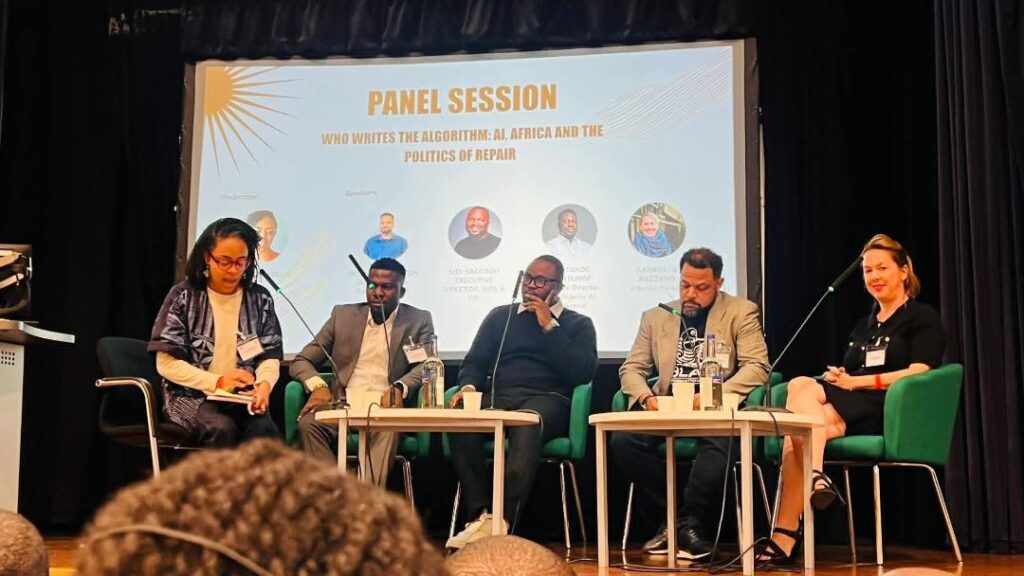
I joined a panel at the London School of Economics for the 12th LSE Africa Summit. The session was titled Who Writes the Algorithm: AI, Africa and the Politics of Repair. It was a good title, and the conversation in the room was thoughtful, but I left with the sense that we are still not stating the harder implications of this conversation as clearly as we should.
The question of who writes the algorithm is important, but it is also incomplete. A more useful question, in my view, is to ask whose knowledge the system is built on in the first place. That matters because what we call “the algorithm” is not just code; it is the outcome of training data, and that data reflects very specific histories, geographies, and power structures.
Africa has over 2,000 languages, yet most of those languages are almost entirely absent from the datasets that underpin today’s AI systems. As a result, the systems that now speak with authority about African contexts did not learn from African societies in any meaningful way. What they have learned about Africa is largely mediated through external documentation, external narratives, and external priorities. That is not simply a technical gap. It reflects a deeper structural imbalance in how knowledge is produced, captured, and reused.
Three points from the conversation stayed with me.
The first is the question of value. Africa plays a central role in the global AI value chain, particularly through the extraction of minerals that power hardware, but it captures very little of the downstream value. This mirrors older patterns we are already familiar with in other sectors, where the continent participates at the level of raw input but is largely excluded from ownership and high-value segments.
The second is the question of knowledge extraction. African journalism, particularly the kind that is rigorous, fact-checked, and grounded in local realities, is increasingly being used to train AI systems. At the same time, we are seeing major licensing deals being signed between AI companies and large Western media organizations. This creates an uneven dynamic where African knowledge contributes to system development without a commensurate share of the economic or institutional benefits.
The third is the issue of access and perception. A significant number of people across the continent are engaging with AI through free or limited versions of these tools. Over time, this shapes how the technology is understood. When people form their expectations of AI based on constrained versions of it, it influences not only usage but also the kinds of claims they make about its capabilities and limitations. This is not just a usability issue; it has implications for how AI is discussed, adopted, and governed.
Another point that came up during the panel, and which I think deserves more attention, is the structure of funding for AI governance work in Africa. A considerable portion of this work is supported, directly or indirectly, by the same companies that governance frameworks are expected to hold accountable. This does not automatically invalidate the work being done, but it does introduce a structural tension that we should be more explicit about. It also helps explain why many policy conversations emphasise innovation and opportunity while paying less attention to extraction, dependency, and long-term control.
This brings me to the idea of “repair,” which was central to the panel.
There is a tendency to frame repair in relatively soft terms (as inclusion, capacity building, or participation in existing systems). Those are useful interventions, but they do not address the underlying structure of the system itself. If we take the idea of repair seriously, then it has to be understood in more structural terms.
Repair, in this context, is about ownership, governance, and distribution. It requires asking who owns the data that is being used, who has the capacity to build and control the systems, who sets the rules that govern them, and who ultimately benefits from their deployment. These are not purely technical questions; they are political and economic questions.
And that is where the conversation becomes more difficult, because meaningful repair would involve a redistribution of power within the current system. It would require moving beyond participation in systems designed elsewhere, toward shaping and governing those systems in ways that reflect local realities and priorities.
If Africa is going to engage seriously with AI, then the goal cannot simply be to be included in the margins of an existing architecture. It has to be to play a role in defining that architecture, in ways that ensure that the continent is not only a source of raw materials and raw data, but also a site of decision-making, value creation, and governance.
That, to me, is what the politics of repair actually demands.