
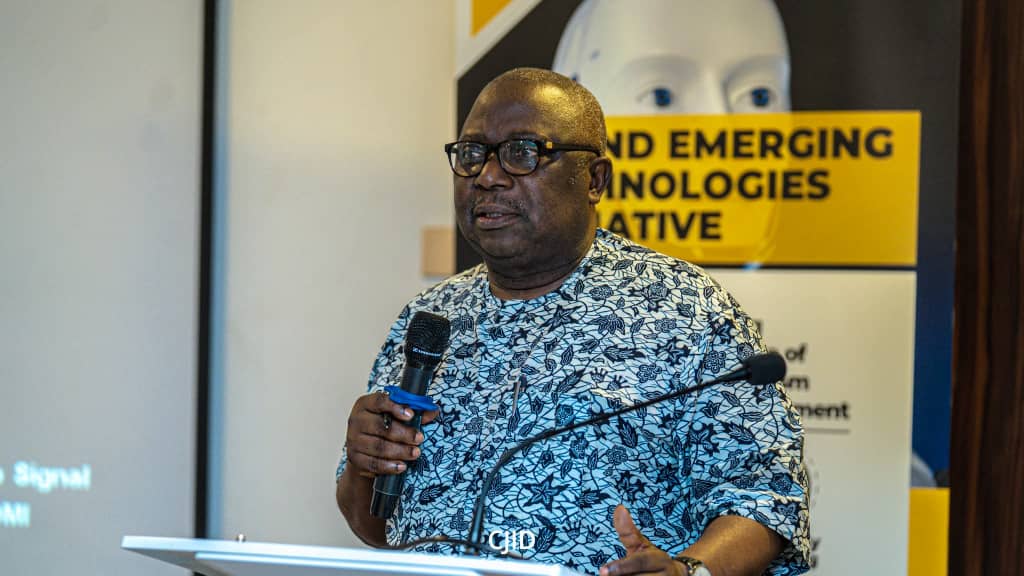
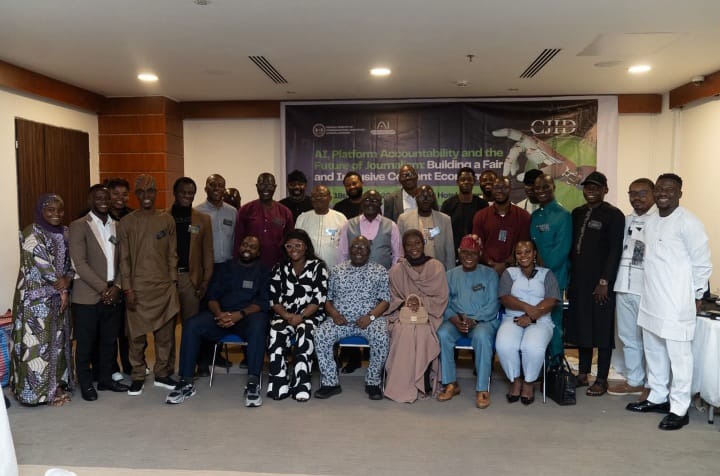
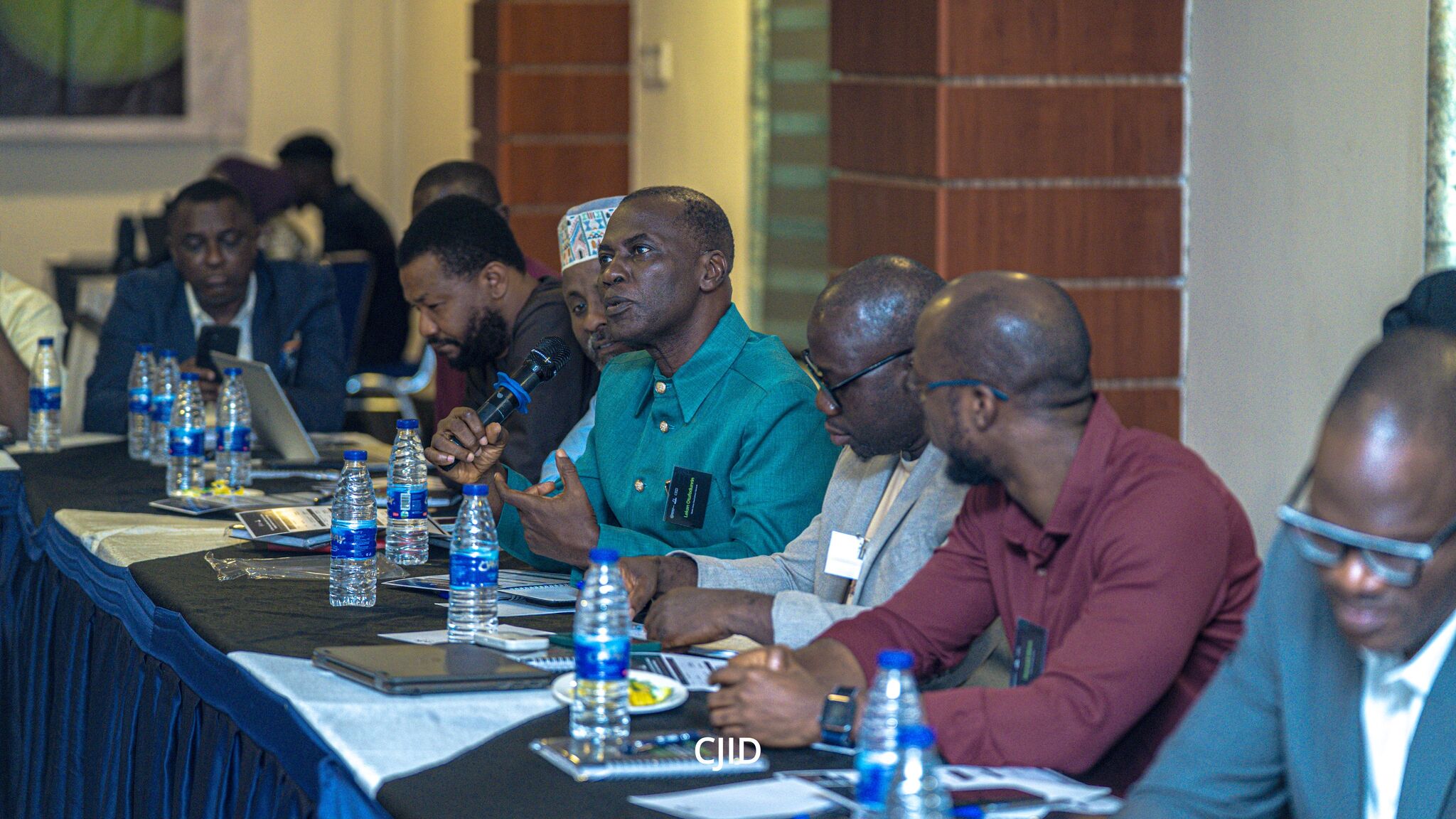
Opening remarks by the CEO of Centre for Journalism Innovation and Development, Mr Dapo Olorunyomi at the AI, Platform Accountability and the Future of Journalism: Building a Fair and Inclusive Content Economy workshop for newsroom leaders.
There is a story about how the information of the world economy was built. We
understand that story much better today than we did while it was unfolding. I want to
begin there this morning because that history tells us something important about the
choices facing journalism in the age of artificial intelligence.
For much of the twentieth century, journalism was one of the most commercially
powerful industries in the world. Its power came partly from the structural position
newspapers, radio stations and television channels occupied in the information
economy. Advertisers seeking mass audiences had few ways to bypass them. If you
wanted to sell soap to a million people in Chicago, you bought space in the Tribune. If
you wanted to reach voters in Lagos, you bought time on the radio. That position
generated revenues that funded some of the greatest journalism the world has ever
produced.
Then the internet arrived. It dramatically expanded access to information and lowered
the barriers to publishing. It also disaggregated the commercial bundle that had made
newspapers financially viable. Classified advertising, which once funded substantial
portions of newsroom budgets in the United States, the United Kingdom and
elsewhere, migrated to specialist platforms. Display advertising moved online, where
rates were a fraction of what print had commanded. The industry saying captured the
transition precisely: analogue dollars became digital dimes, and eventually mobile
pennies.
Advertising revenues increasingly migrated towards technology platforms. Google built
an extraordinarily powerful search business around organising and making the web
discoverable. Facebook built a social network through which people discovered,
discussed and shared journalism. Both created enormous economic value. News
publishers continued bearing the substantial costs of producing journalism while
platforms captured an increasing share of the advertising market surrounding digital
information and attention.
The consequences were profound. Across the United States, local newspapers that had
covered city halls, school boards and courts for generations disappeared. More than
2,000 local newspapers closed between 2005 and 2020. Newsroom employment
declined dramatically. Similar pressures affected local and regional journalism
elsewhere. The journalism most vulnerable to these changes was often the journalism
communities needed most: reporting that monitored local institutions and held power
accountable.
Governments, regulators and publishers eventually responded. Australia introduced
the News Media Bargaining Code in 2021, creating a regulatory framework that
encouraged negotiations between digital platforms and news publishers. The
European Union strengthened publishers’ rights through its Copyright Directive.
Publishers pursued litigation, commercial negotiations, subscriptions and other
approaches to rebuilding the economics of journalis-m. Some adapted successfully.
Others disappeared.
There is a lesson in that history that deserves our attention today. Structural shifts in
the information economy move faster than the institutions they disrupt. Markets
develop, business models emerge, regulatory precedents are established and
commercial norms become entrenched. Organisations that arrive late often discover
that they are negotiating within systems whose fundamental rules have already been
determined.
Another structural transformation is now underway.
Artificial intelligence is creating a new relationship between technology companies and
the institutions that produce knowledge. Since the emergence of generative AI,
technology companies have entered licensing and partnership agreements with
publishers including News Corp, the Associated Press, the Financial Times, Axel
Springer and others. These arrangements differ substantially. Some involve archives.
Some provide access to current journalism. Some provide attribution or links. Some
support AI products or retrieval systems. Some involve direct financial compensation.
The technologies involved are different, the uses of content vary considerably, and
many of the legal questions remain unsettled. Yet the underlying political-economic
questions are becoming increasingly urgent. How should value be recognised when
one industry creates knowledge upon which another increasingly depends? How
should bargaining power be distributed? Who participates when the rules are being
established?
An emerging market for high-quality journalistic content now exists within the AI
economy. It remains young, opaque and deeply unequal. Its rules are being shaped
through early commercial agreements, litigation and regulatory intervention. Decisions
being taken today will influence who participates, on what terms, with what
protections and with what compensation for years to come.
Africa enters this moment from a very different starting point.
African journalism has always operated within difficult economics. The
independence-era newspapers of Nigeria, Ghana, Kenya, Senegal, South Africa and
elsewhere combined commercial publishing with political formation, nationalist
consciousness and democratic aspiration. They documented independence
movements, challenged governments and created spaces for political argument. Across
many countries, journalists worked under political harassment, legal restrictions and
severe economic constraints.
Those constraints persisted after independence. African publishers have faced thin
advertising markets, high production costs, currency volatility, difficult distribution
networks, low purchasing power among audiences and political environments that
could make independent journalism commercially dangerous. The digital transition
intensified many of these pressures.
And yet African newsrooms built extraordinary journalism ecosystems. They produced
investigations into corruption, public health failures, electoral manipulation,
environmental destruction, conflict and corporate misconduct. They developed digital
publishing models capable of reaching enormous audiences. They created journalism
that shaped political debates and held institutions accountable.
Much of that journalism was made freely accessible because broad public access has
always been central to its civic value and because subscription models remain difficult
in markets where large portions of the population cannot sustain recurring payments
for news. The result is an extraordinary digital archive of African knowledge. Decades
of journalism documenting our governments, elections, conflicts, economies, cultures,
communities and institutions now exist on the open web.
Artificial intelligence has introduced a new dimension to the economics of that
openness.
Large AI systems have been developed using enormous quantities of digital
information, including material gathered from the publicly accessible web. This has
raised profound questions for publishers around the world about copyright, consent,
attribution, compensation and the economic value of journalistic content. For African
publishers, it also raises the question of our place in the emerging AI content
economy.
Major commercial arrangements have already been announced between AI companies
and publishers elsewhere in the world. African publishers remain the qstrikingly
underrepresented in publicly disclosed agreements even though African journalism
forms an important part of the world’s digital knowledge infrastructure.
Think about what this means in practical terms. If an AI system can answer questions
about Nigerian elections, Ghanaian politics, conflict in the Sahel, African public
health, corruption, culture or economic policy, much of the reliable public knowledge
about these subjects exists because somebody documented it. A reporter attended the
press conference. A journalist travelled to the community. An editor checked the facts.
A newsroom paid for the investigation. A photographer documented the event.
Researchers assembled the evidence. Publishers maintained archives over decades.
That knowledge has value.
South Africa has already begun confronting the economic relationship between digital
platforms and journalism. In November 2025, the South African Competition
Commission concluded its Media and Digital Platforms Market Inquiry. Its findings
recognised significant imbalances in bargaining power between publishers and major
technology platforms and examined the distribution of value between digital platforms
and the news industry.
The resulting arrangements included a R688 million media support package involving
Google and YouTube, covering measures including content licensing, innovation
support and capacity building. The Commission also addressed the ability of
publishers to bargain collectively over AI-related content licensing.
That development matters beyond South Africa because it demonstrates that African
regulators can examine the relationship between global technology companies and
local journalism through the realities of African media markets. It establishes an
African precedent at precisely the moment when the economics of information are
changing again.
Nigeria now has its own opportunity to shape this conversation.
The history of Nigerian journalism gives us every reason to take that responsibility
seriously. It runs through Herbert Macaulay and the Lagos Daily News, through
Nnamdi Azikiwe and the West African Pilot, through the Nigerian Tribune, Daily
Times, Punch, The Guardian and generations of newspapers that helped shape the
political consciousness of this country. It runs through military governments that shut
newsrooms, imprisoned journalists and attempted to suppress reporting. It runs
through the democratic transition, the expansion of broadcasting and the emergence
of digital journalism.
Today that tradition continues through a diverse ecosystem of legacy organisations,
digital-native publications, investigative platforms, community media, broadcasters
and independent journalists producing journalism for millions of Nigerians every day.
Nigerian newsrooms have exposed corruption, documented insecurity, investigated
public procurement, scrutinised elections, uncovered human-rights abuses and
explained this country to itself and to the rest of the world.
All of that knowledge has a production cost. A serious investigation may require
months of a reporter’s time. Newsrooms pay for travel, data, editing, legal support,
security, technology and distribution. Editors make difficult decisions under pressure.
Publishers maintain archives that accumulate institutional knowledge over decades.
Much of the resulting journalism is published openly on the internet.
Consider a Nigerian journalist who spends six months investigating military
procurement corruption and publishes a 4,000-word investigation. That investigation
becomes available to readers around the world. It may also become accessible to
crawlers, aggregators and organisations assembling enormous datasets from the
public web.
We know that large AI systems have been developed using vast quantities of web data.
Publishers generally have far less visibility into which specific articles entered
particular datasets, how their material was used, what value it contributed and what
rights should attach to that use. Courts and regulators around the world are now
grappling with these questions.
What we can already see is the enormous contribution Nigerian journalism has made
to the digital information environment from which contemporary artificial intelligence
has emerged.
This is why the debate about AI and journalism must go beyond whether reporters can
use a chatbot to summarise a document or draft a headline. Those are useful
questions for newsrooms, but the transformation underway reaches much deeper into
the economics and governance of journalism.
It reaches our archives. It reaches intellectual property. It reaches the discoverability
and attribution of journalism. It reaches competition in digital markets. It reaches the
bargaining relationship between publishers and some of the world’s largest
corporations. It reaches the ability of independent media institutions to finance the
production of reliable public knowledge.
And something significant has happened in Nigeria.
In July 2026, President Bola Ahmed Tinubu directed the Federal Competition and
Consumer Protection Commission to investigate major digital and technology
platforms following a petition from the Nigerian Press Organisation. That petition
brought together the Newspaper Proprietors’ Association of Nigeria, the Nigerian Union
of Journalists, the Broadcasting Organisations of Nigeria, the Nigerian Guild of Editors
and the Guild of Corporate Online Publishers.
The issues under consideration go directly to the future of Nigerian journalism: the
commercial use of journalistic content, the relationship between publishers and
technology platforms, AI training, bargaining power and competition within digital
markets.
Nigeria therefore enters this global debate at a consequential moment. A regulatory
process is underway. An international licensing market is developing. African
precedents are emerging. AI companies are making decisions about which publishers
they engage, what content they value and what forms those relationships will take.
Nigerian media institutions must develop the capacity to engage that environment
from a position of knowledge and preparedness.
That begins with understanding the intellectual property sitting in our archives.
Publishers need to know what they own, what rights they hold and how their content
is being accessed. Newsrooms need stronger technical understanding of crawling,
indexing and AI systems. They need policies governing the use of AI within their own
organisations and clearer positions on external use of their journalism. They need
legal and commercial capacity to evaluate licensing proposals. They need to
understand the distinctions among copyright claims, competition questions and
commercial negotiations.
There is also a collective-action problem that deserves serious attention. An individual
Nigerian publisher negotiating with a global technology company faces an enormous
imbalance in information, resources and bargaining power. The Nigerian media
industry acting together enters that conversation very differently.
Our history has often encouraged competition between media organisations.
Competition is healthy and necessary in journalism. Yet there are moments when
institutions that compete editorially still share fundamental economic interests. The
sustainability of journalism is one of them. The protection of intellectual property is
another. The terms under which global AI companies access Nigerian journalistic
content may become another.
The choices we make during this period will extend far beyond licensing payments.
They will shape attribution and transparency. They will influence the visibility of
Nigerian and African knowledge within AI systems. They will affect competition in our
information markets. They will influence whether publishers can continue financing
the expensive work of producing reliable public information.
They may also shape what the next generation understands journalism to be worth.
The previous digital transition taught our industry a difficult lesson. Technological
change can create extraordinary opportunities while simultaneously redistributing
economic power. By the time those consequences become obvious, many of the
underlying rules may already have hardened.
This time, we can see the transition while it is still unfolding.
That gives us agency.
Journalists spend their lives observing, verifying, documenting, contextualising and
explaining the world. Through that work, journalism has created an enormous body of
reliable public knowledge. Artificial intelligence increases the economic and social
importance of that knowledge.
The institutions that produce it deserve a meaningful place in the economic and
governance arrangements surrounding its use. They should enter those conversations
as rights holders, credible counterparties and participants in a market whose rules are
still being written.
For African journalism, the stakes extend further. AI systems will increasingly mediate
how people encounter information about our countries, our histories, our politics and
our societies. The quality, diversity and visibility of African knowledge within those
systems will matter enormously. A sustainable African media ecosystem is therefore
part of the infrastructure required for an AI future that understands Africa with depth,
accuracy and context.
Nigerian journalism has already contributed to the knowledge infrastructure on which
artificial intelligence is being built.
We now have an opportunity to participate in shaping the economic and governance
arrangements that will surround that knowledge for decades to come.
That opportunity is before us today. And what we do with it is up to us.