

“All of us have to choose to respond to the challenges of our own times; for me, the challenge is HIV/AIDS.” ~ Omololu Falobi
He was praised for his dauntless drive for advocacy against HIV/AIDS. He was loved by his family, friends, colleagues, and the international community. Through information dissemination, his organization JAAIDS led in the fight against HIV/AIDS in Nigeria and beyond. He was a devoted father, activist, pioneering journalist, friend, brother, leader, and visionary. Until and even after death, he was respected as excellence personified.
He was Omololu Falobi.
HIV/AIDS in Nigeria was a major issue in the 2000s, when an estimated seven million people were living with HIV/AIDS. At that time, Omololu’s journalism career was just starting as a staff reporter at The Punch after finishing his National Youth Service Corps (NYSC). He rose through the ranks to Features Editor of Sunday Punch before leaving to start Journalists Against AIDS (JAAIDS) full-time as Executive Director in 2000—a move influenced by the death of Afrobeat legend Fela Kuti from AIDS, among other reasons. And that was when the fire that never dimmed sparked in the young man.
Omololu’s end goal was to create awareness and fight the stigma around HIV/AIDS through media advocacy. As one of the earliest users of the internet, he used his digital literacy to advocate for a better world without HIV/AIDS. It didn’t end online—with that same fire, he organized workshops, trainings, and seminars where he sensitized journalists on HIV and public health in general.
Within just five years of steering Journalists Against AIDS (JAAIDS), he became a leading HIV/AIDS advocate across Africa. The passion that fueled the creation of JAAIDS co-established the Nigeria AIDS e-Forum, co-launched the Nigerian HIV Vaccine and Microbicide Advocacy Group (NHVMAG), and made him a core pioneering member of the Treatment Access Movement (TAM) Nigeria as well as a leader of the African Civil Society Coalition on HIV and AIDS.
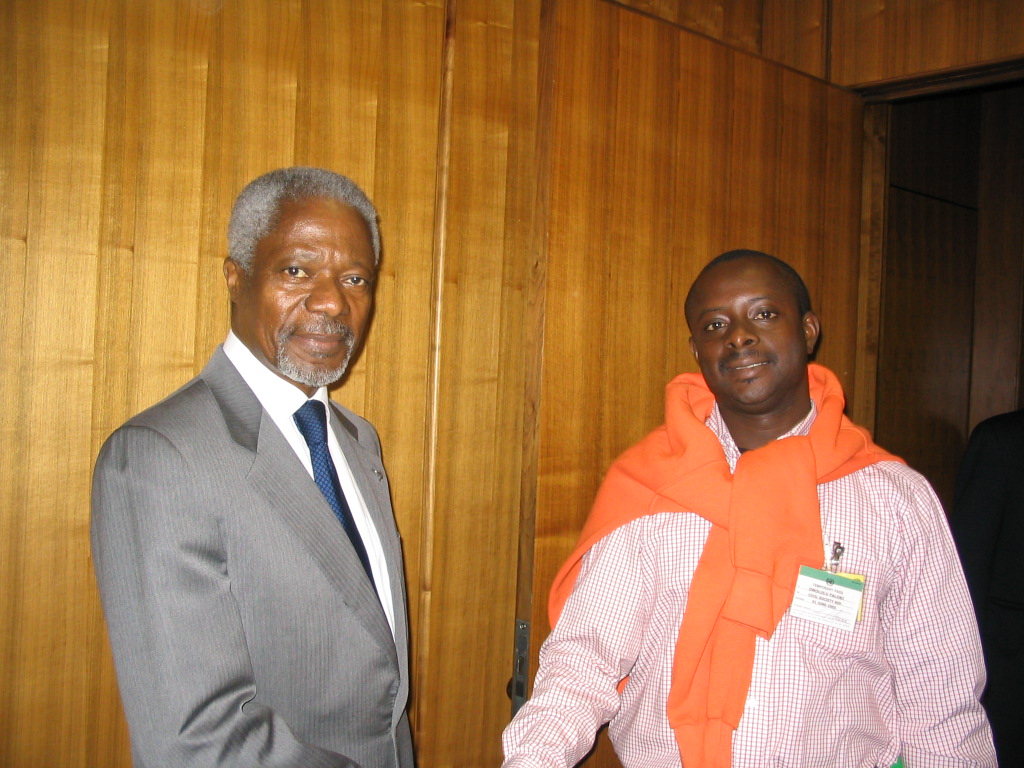
In 2001, he served as Media Coordinator for the African Union Summit on HIV/AIDS, Tuberculosis, and Malaria. Falobi became the African NGO representative on the board of the Joint United Nations Programme on HIV/AIDS from 2004 to 2005. He was a board member of The Black AIDS Institute (formerly the African American AIDS Policy & Training Institute, Los Angeles, USA), a board member of the Nigeria Youth AIDS Programme (NYAP), and the Positive Life Organization (a support group for people living with HIV/AIDS).
Falobi was also part of the Chicago Afrobeat Project recording group, working passionately with them to create appropriate messages for their performances. He also contributed to several important publications on HIV/AIDS, including the Scorecard of Media Reporting of HIV/AIDS in Nigeria and the Media Handbook on HIV/AIDS in Nigeria.
Falobi’s advocacy against HIV/AIDS did not go without international recognition. In 2000, he was honored with the Highway Africa Award for Innovative Use of New Media and received the International AIDS Society’s Young Investigator Award. The next year, he was appointed an Ashoka Fellow, joining a global network of social entrepreneurs recognized for their innovative approaches to societal challenges.
Falobi had always been exceptional. It showed in his early academic brilliance, having a double promotion in primary school and gaining admission into secondary school at just 10 years old. It didn’t end there—during his time at Ijebu-Ijesa Grammar School, Omololu was a star student who won numerous awards. So gifted was he that at 15 years old, he gained admission to the University of Ife (now Obafemi Awolowo University) to study Dramatic Arts, and later pursued a master’s degree in political science at the University of Lagos.
Hailing from a family rooted in Iwoye-Ijesa, Osun State, Omololu married Aderonke Abosede Falobi (née Odewande) in 1998. Their union was blessed with three children: Ayomide, Olamide, and Aramide. Even as busy as he was, Omololu made time for his wife and kids. His love for them was neither compromised by his busy schedule nor by his passion for an HIV/AIDS-free world—he balanced them through and through.
To this day, many still attest to the qualities Omololu possessed as he ran JAAIDS: he was an empowering leader who never sought to be the be-all and end-all of the organization, and a master delegator who led with radical transparency and trust. He made sure everyone around him was well informed and carried along. This explains why years after his death, his organization still lives up to the standards of best practice and the validity of the founder’s dream.
On October 5, 2006, at 35 years old, Omololu Falobi’s life was tragically cut short as he returned home from a speaking session for young professionals. He was shot several times in the forehead by unknown assailants in Lagos. His death marked the end of a life dedicated to combating HIV/AIDS, and the world mourned his painful exit.
There are several enduring lessons that can be drawn from his life and work. The ends of the earth can be reached with the right message, the right skills, and the right tools. It’s one thing to dream, another to pursue it—it is a wholesome feeling to do both. The biggest lesson: it’s not by how long we live, but how well.
Marcus Aurelius once said, “It is not death a man should fear, but he should fear never beginning to live.” Though his time on earth was cut short, Omololu lived an inspiring life, driven by a strong command of the media, a successful fight against HIV/AIDS, deep family ties, and a standard of excellence.
He had a purposeful run on earth, one which after 20 years is still praised locally and internationally. His memory is still evergreen. And as the Danish proverb says, “Good men will surely die, but death cannot kill their names.”
His name still lives on. His name is Omololu Falobi.