Media rights advocates demand urgent action as report reveal systemic failures in protecting women journalists in Afghanistan, Mexico and Iraq
Media experts and human rights advocates have raised the alarm over growing threats, harassment and institutional failures confronting female journalists worldwide, calling for urgent action to guarantee their safety and access to justice.
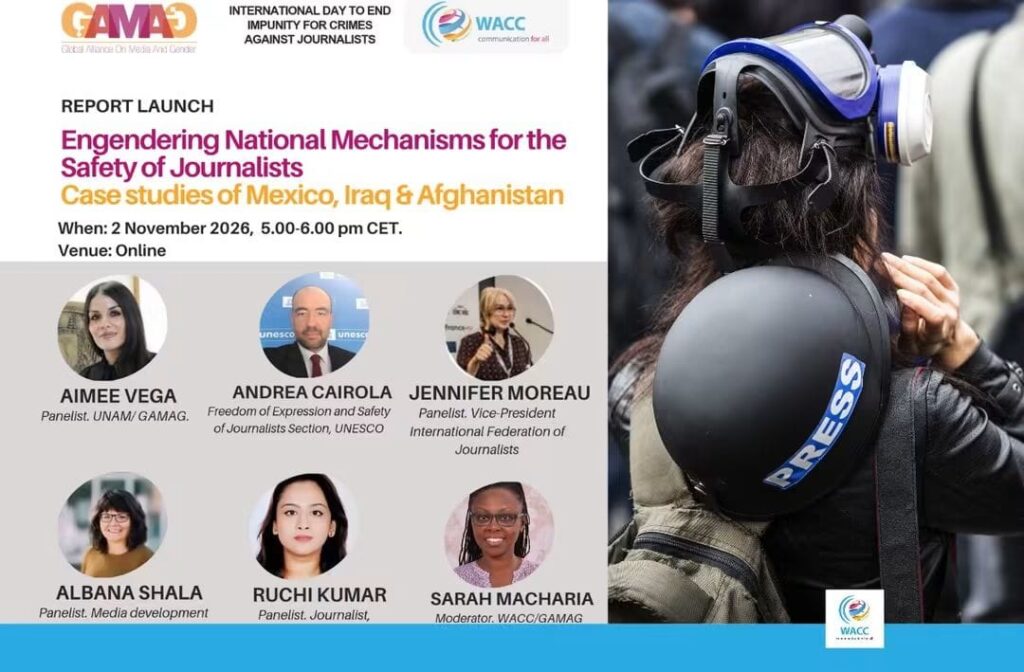
The warning came on November 2, during the commemoration of the International Day to End Impunity for Crimes against Journalists, where stakeholders unveiled a research report exposing critical gaps in national protection mechanisms for women journalists in Afghanistan, Mexico and Iraq.
The report, titled Engendering National Mechanisms for the Safety of Journalists, was jointly launched by the Global Alliance on Media and Gender (GAMAG) and the World Association for Christian Communication (WACC).
It examined how weak government institutions, gender discrimination, political interference, online abuse and entrenched social prejudices continue to undermine efforts to protect women working in the media.
Opening the virtual event, GAMAG Chair, Aimée Vega Montiel, warned that women’s rights could never be taken for granted, particularly during political, economic and religious crises.
Quoting a historic reflection on women’s rights, she said: “Never forget that it will be enough for a political, economic, or religious crisis for the rights of women to be called into question. These rights are never acquired. You will have to remain vigilant throughout your life.”
The event, moderated by GAMAG General Secretary and WACC Gender and Communication Consultant, Sarah Macharia, featured representatives of UNESCO, the International Federation of Journalists (IFJ) and regional research teams.
Participants examined the safety of female journalists through an intersectional gender lens, highlighting the failure of existing protection structures to adequately address the specific risks women face.
Afghanistan: Taliban restrictions push female journalists out of the profession
One of the most disturbing accounts came from journalist and Afghanistan case study researcher, Ruchi Kumar, who described the deteriorating conditions for women journalists following the Taliban’s return to power in August 2021.
She said restrictions imposed on women had effectively pushed many female media practitioners out of public life, with those still working facing intimidation, harassment and restrictions on their movement.
”Female journalists need a male guardian or family members to accompany them to work,” Kumar said, stressing that women were routinely discouraged from taking up jobs requiring them to leave their homes.
According to her, the restrictions have also disrupted the training and recruitment of new female journalists, threatening the future of women’s participation in Afghanistan’s media industry.
”No new female journalists have been trained as they remain exposed to physical abuse, sexual abuse, and psychological abuse,” she explained.
Kumar also drew attention to the worsening mental health challenges confronting Afghan women journalists, noting that fear and insecurity had made it difficult for many victims to report abuses.
She disclosed that 20 per cent of female journalists did not feel comfortable reporting abuse, citing the risks associated with seeking justice in a system where women have limited access to legal representation.
”Because there are no female lawyers, if a woman is unable to prove her accusations, she is accused and charged with the moral crime she went to report,” she said.
The researcher further described how restrictions on women’s participation in broadcasting had expanded, with female journalists facing bans on appearing on television, showing their faces and, increasingly, using their voices.
Although hundreds of journalists have sought asylum outside Afghanistan, some independent media initiatives continue to document developments in the country despite the risks.
Among them is Zan Times, led by Editor-in-Chief Zahra Nader, which continues to investigate issues affecting Afghan women, alongside international press freedom organisations such as Reporters Without Borders.
Mexico: Funding cuts weaken journalist protection system
In Mexico, the research identified institutional shortcomings, inadequate funding and gender discrimination as major obstacles to the safety of female journalists.
Women journalists reportedly face both physical attacks and persistent online harassment, including hate speech and image-based abuse.
The country’s Federal Protection Mechanism, established in 2012 to protect human rights defenders and journalists, was identified as facing chronic funding constraints and weaknesses in its response to gender-specific threats.
The report also highlighted sexist assumptions in risk assessments and the absence of adequate gender-responsive protection protocols.
Iraq: Harassment, corruption discourage women from seeking help
The findings from Iraq revealed another layer of challenges, with social stigma, political interference and alleged police corruption discouraging female journalists from reporting attacks.
According to the research, more than 65 per cent of female journalists in the country reported experiencing harassment in their workplaces or while carrying out field assignments.
The report identified fear of police corruption and political interference, alongside social accusations involving alleged moral misconduct, as major barriers preventing women from seeking formal protection.
It also questioned the effectiveness of Iraq’s National Committee for the Safety of Journalists, noting that government agencies had failed to follow up on the majority of formal protection requests submitted by women.
The findings suggested that establishing protection committees alone was insufficient without effective implementation, accountability and gender-sensitive procedures.
IFJ, UNESCO demand stronger protection for women journalists
Reacting to the findings, experts called for a shift from monitoring attacks against female journalists to establishing practical mechanisms capable of preventing violence and holding perpetrators accountable.
Media development expert and human rights defender, Albana Shala, who represents GAMAG, advised that journalist safety mechanisms must operate independently and possess the authority to investigate abuses and hold state actors accountable, stressing that ” the state is part of the priblem”
Similarly, International Federation of Journalists (IFJ) Vice-President, Jennifer Moreau, called on newsroom unions to strengthen workplace protections by incorporating binding safety provisions into collective bargaining agreements. “If their country can’t protect them, how do we get them out or develop safety plan, we need cooperation to take this to an international level,” she explained.
Moreau advocated stronger corporate protection structures, international cooperation on asylum for threatened journalists and the development of an international convention on journalist safety that adequately addresses gender-specific risks.
For UNESCO, Deputy Secretary of the International Programme for the Development of Communication (IPDC), Shola McCabe, drew attention to rising impunity and targeted killings of journalists, particularly in conflict-affected areas.
She urged academic institutions and civil society organisations to intensify research into technology-facilitated gender-based abuse, while calling on technology companies to take greater responsibility for addressing online attacks.
McCabe also stressed the importance of gender-disaggregated data in shaping effective public policies and monitoring the safety of journalists.
Adding UNESCO’s institutional perspective, Senior Programme Specialist at its Freedom of Expression and Safety of Journalists Section, Andrea Cairola, reaffirmed the organisation’s commitment to supporting gender-responsive safety mechanisms worldwide.
Stakeholders seek end to impunity
The discussions ended with a renewed call for media organisations, governments, international institutions and civil society groups to work together to strengthen protections for female journalists.
Organisers stressed that women journalists must be protected regardless of whether they work in traditional newsrooms, report from conflict zones or operate in exile.
The report’s findings underscored a central concern: protecting journalists requires more than condemning attacks after they occur. It demands effective institutions, independent investigations, accountability for perpetrators and policies that recognise the particular dangers confronting women in the media.
As the world marks the International Day to End Impunity for Crimes against Journalists, advocates insist that the fight against attacks on the press cannot be complete while female journalists continue to face violence, intimidation and barriers to justice.
REPORT: Call for urgent action on safety of women journalists