
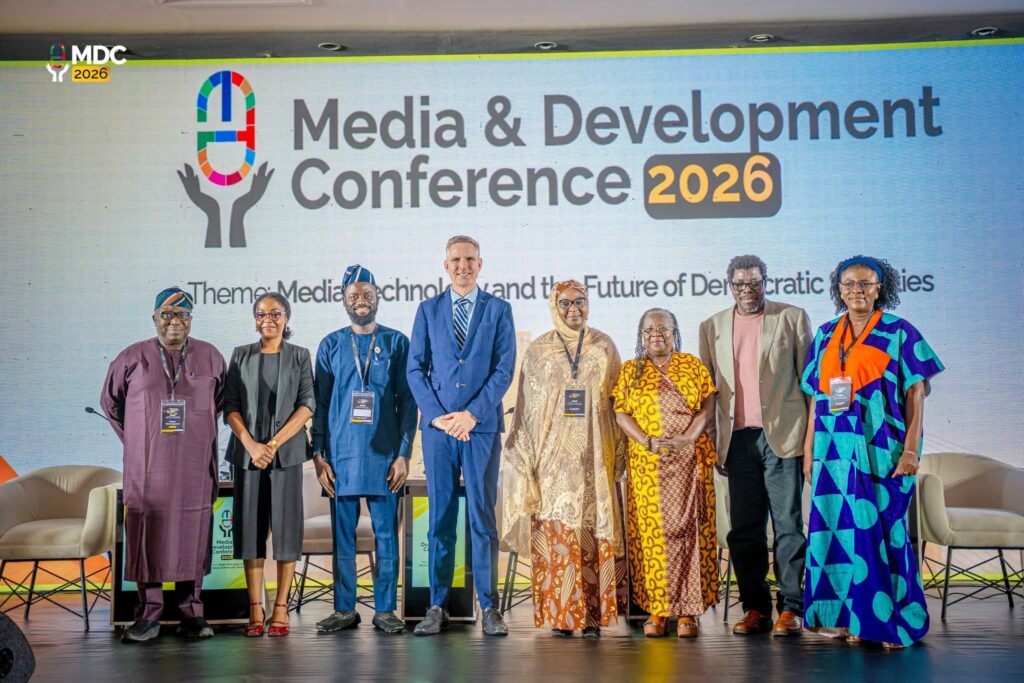
Media leaders have urged journalists to acquire new skills, embrace emerging technologies and strengthen professional institutions to remain relevant in an increasingly digital media environment.
They made the call at the opening of the 2026 Media and Development Conference organised by the Centre for Journalism, Innovation and Development (CJID) in Abuja on Monday.
The speakers stressed that the rapid transformation of the media landscape, particularly through artificial intelligence and digital platforms, requires journalists to continuously develop their professional capacities while maintaining ethical standards and editorial independence.
CJID’s Chief Executive Officer, Mr Dapo Olorunyomi, who gave the welcome address, said technology was creating new opportunities for journalism but warned that journalists must not allow technological convenience to compromise professional judgment.
He identified data journalism, open-source intelligence, collaborative fact-checking and mobile technology as some of the tools that had expanded the capacity of African journalists to investigate issues, expose wrongdoing and reach underserved communities.
Olorunyomi said artificial intelligence also presented challenges, including the production of synthetic images, audio and videos, the reproduction of historical biases and the spread of misinformation at a speed that could overwhelm newsrooms’ verification capacity.
He urged media organisations to develop clear editorial policies on the use of artificial intelligence and ensure that machine-generated content was subjected to rigorous verification.
Olorunyomi also called for stronger media institutions with credible editorial policies, sustainable business models and the capacity to train the next generation of journalists.
He said the future of journalism should not depend solely on the courage and sacrifices of individual reporters, noting that journalists could become exhausted, intimidated or forced out of the profession without institutional structures to sustain their work.
According to him, media development should move beyond dependence on successive projects to building institutions with long-term strategies for professional growth and survival.
The Deputy Director of the MacArthur Foundation Africa Office, Dr Amina Salihu emphasised the need to equip journalists with the relevant tools, skills and opportunities to respond to changes in the media industry.
She said journalism was an essential infrastructure for democracy and that media organisations needed sufficient independence, flexibility and agility to adapt to technological developments.
Salihu challenged journalists and other stakeholders to familiarise themselves with Nigeria’s National Artificial Intelligence Strategy, arguing that meaningful participation in technology governance required an understanding of the policies shaping the sector.
She also called for greater collaboration among African media professionals to ensure the continent played an active role in shaping global conversations on technology rather than remaining merely a source of data and content.
The Deputy Ambassador, Netherlands Embassy in Nigeria, Ronald Sonnemans said the resilience and creativity of journalists remained important in the face of growing financial pressures, threats and restrictions on press freedom.
She noted that independent newsrooms were struggling to remain financially sustainable in several countries, warning that the decline of independent journalism affected society’s ability to access credible information and hold public officials accountable.
The Secretary-General of the African Public Relations Association, Dr Omoniyi Ibietan urged communication professionals to adopt a more inclusive and cooperative approach to engaging audiences saying that the changing communication environment required practitioners to move beyond simply broadcasting information and instead recognise audiences as partners in meaningful conversations.
Omoniyi also stressed the importance of responsible communication in preventing hate speech and violence and promoting human development.
The conference brought together media professionals and development stakeholders to discuss the changing media landscape, the impact of technology on journalism and the need to strengthen the institutions supporting public-interest reporting.