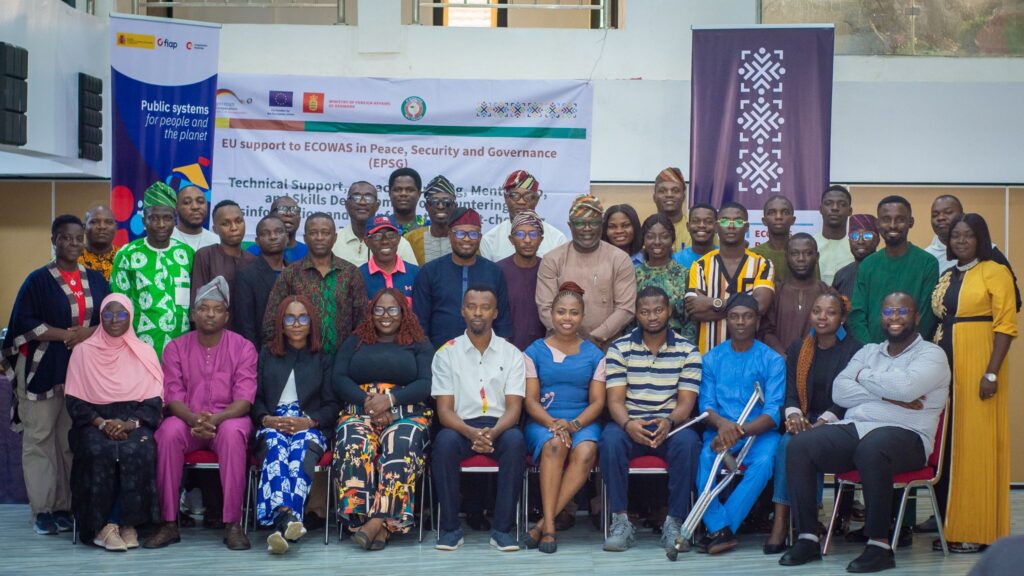
On June 24, the three-day Lagos Regional Workshop under the EU Support to ECOWAS in Peace, Security and Governance (EPSG) Project, organised by FIAP in collaboration with FactCheckAfrica ended with 35 journalists, fact-checkers, researchers, and civic actors from the South East and South West regions of the country participating.
Convened by FIAP in collaboration with FactCheckAfrica, the workshop is designed to strengthen the capacity of frontline information actors to respond to misinformation, disinformation, hate speech, coordinated online manipulation, and emerging AI-related threats ahead of key electoral milestones, including the (recently held) Ekiti and Osun governorship elections and Nigeria’s 2027 general elections.
Day one focused on one critical question: What does Nigeria’s information environment look like as we approach another major electoral cycle?
Leading this conversation was Tonye Bakare, AFP Nigeria Correspondent, who facilitated a thought-provoking session on the pre-electoral information landscape. Participants examined emerging disinformation trends, key actors shaping online narratives, and the disproportionate impact of information disorder on women and young people, two groups often targeted during election periods.
The conversation then shifted from understanding the problem to building solutions.
In a practical session on Verification and Fact-Checking, Mustapha Lawal, Researcher and Fact-Checker at FactCheckAfrica, guided participants through essential verification workflows, including reverse image search, source authentication techniques, open-source intelligence (OSINT) methods, and the responsible use of AI-assisted verification tools for electoral content.
Participants were challenged to move beyond theory during the Verification Lab, where they worked in teams to investigate real-world electoral information case studies. Using professional fact-checking methodologies, they conducted image verification exercises, analysed suspicious claims, authenticated sources, and applied OSINT techniques to uncover the truth behind complex information scenarios.
The first substantive session of Day 2, facilitated by Mr. Lekan Otufodunrin, Executive Director of Media Career Development Network, explored the growing challenge of hate speech and polarising political narratives in electoral contexts.
Participants examined how harmful narratives are deliberately designed to exploit identity, deepen divisions, manipulate emotions, and influence voter behaviour.
Facilitated by Hannah Ajakaiye, Founder and Editor of FactsMatterNG, the session on Gender-Sensitive and Youth-Inclusive Reporting challenged participants to rethink how women, young people, and marginalised groups are represented within political and electoral narratives.
The discussion highlighted the importance of moving beyond stereotypes and tokenism to ensure that election reporting reflects the realities, priorities, and contributions of all citizens.
The afternoon session placed participants at the centre of the learning process.
Working in groups, participants analysed complex electoral communication scenarios involving hate speech, misinformation, narrative manipulation, and representation challenges. They were tasked with developing editorial responses, mitigation strategies, and communication approaches grounded in ethical journalism principles.
The day concluded with group presentations and a lively plenary discussion where participants defended their approaches, exchanged perspectives, and collectively developed practical protocols that can be adapted within newsrooms, civil society organisations, and civic engagement initiatives.
The third day opened with a practical and timely session on Safe Journalism During Elections, facilitated by Adejumo Kabir, Senior Researcher and Programme Manager at Good Governance Africa (GGA), representing Mojeed Alabi, Team Lead at DevReporting and former Premium Times reporter.
The conversation moved beyond traditional newsroom discussions to confront the realities journalists increasingly face during elections: digital harassment, coordinated attacks, surveillance, physical threats, psychological stress, and the need for emergency preparedness.
Kabir also facilitated an engaging session on Media, Accountability and Democratic Resilience, examining the indispensable partnership between media organisations and civil society actors in safeguarding democratic processes.
A defining moment of the day was the official unveiling of the Safe Journalism Toolkit, jointly led by FactCheckAfrica and FIAP.
The toolkit represents a practical resource designed to support journalists and media practitioners with accessible guidance on safety protocols, ethical reporting standards, and resilience strategies during electoral periods. Delivering remarks during the unveiling, Olasupo Abideen, Founder of FactCheckAfrica, emphasised that protecting democratic integrity requires not only accurate information but also safe, supported, and resilient media ecosystems capable of serving the public interest.
The workshop then shifted from knowledge-sharing to implementation.
Facilitated by Joseph Chidiebere Osuigwe, Technical Advisor on Mass Media and Civil Society under the EU Support to ECOWAS in Peace, Security and Governance (EPSG) Project, participants engaged in an intensive Action Planning Clinic, developing structured institutional and individual roadmaps with measurable commitments for the months ahead.
The workshop concluded with the collective drafting, review, and adoption of a Participants’ Communiqué, capturing shared commitments towards electoral peace, information integrity, democratic accountability, ethical journalism, and stronger collaboration between media and civil society actors.
As Nigeria moves closer to the 2027 elections, the conversations that began here will continue through partnerships, mentorship, and collective action across communities and newsrooms nationwide.
This 3-day workshop is organized by the Fundación para la Internacionalización de las Administraciones Públicas (FIAP), F.S.P., in collaboration with FactCheckAfrica under the framework of the EU Support to ECOWAS in Peace, Security and Governance (EPSG) Project.