
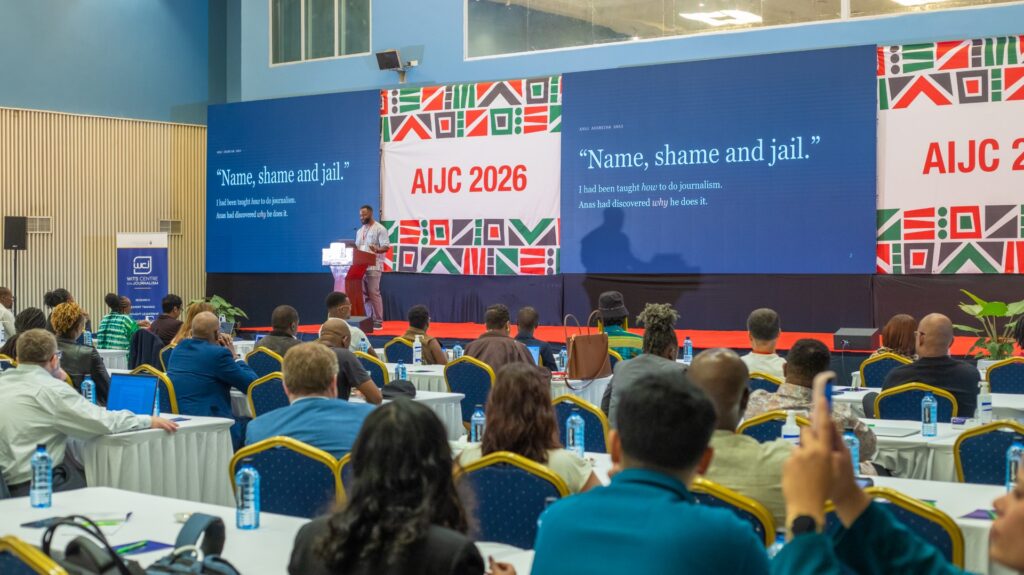
A review of the 22nd African Investigative Journalism Conference, (AIJC) Nairobi, Kenya | November 10–12, 2026
Investigative journalism in Africa is undergoing significant changes, driven by artificial intelligence, digital surveillance, environmental challenges, cross-border investigations and growing threats to journalists.
These issues dominated discussions at the 22nd African Investigative Journalism Conference (AIJC), which took place from November 10 to 12, 2026, at the Edge Convention Centre in Nairobi, Kenya.
The conference brought together more than 500 delegates from 69 countries, making it the largest gathering in its 22-year history. A total of 339 participants were attending for the first time.
Organised by the Wits Centre for Journalism in partnership with the Aga Khan University Graduate School of Media and Communications, the conference marked a significant milestone. It was the first time the annual gathering, previously held in Johannesburg, South Africa, took place outside the country.
The conference offered important lessons about the changing demands of investigative journalism, new reporting opportunities, emerging technologies and the need for professional collaboration.
Here are some of the major highlights and lessons.
Climate change and investigative journalism: Kumi Naidoo’s challenge
One of the major keynote presentations was delivered by Kumi Naidoo, President of the Fossil Fuel Treaty Initiative.
His presentation focused on the climate crisis and the responsibility of journalists to investigate its causes, identify those responsible and hold powerful interests accountable.
The message was particularly relevant to African journalists covering environmental degradation, extractive industries, pollution, deforestation and the activities of multinational corporations.
Climate reporting should not be restricted to reporting floods, droughts, rising temperatures and other environmental disasters.
Journalists must investigate the policies, businesses, political decisions and financial interests contributing to these problems.
Lesson for Nigerian journalists: Investigate the people and institutions behind environmental problems. Reporting on oil pollution in the Niger Delta, illegal mining, deforestation and industrial pollution should go beyond describing their effects to examining responsibility, regulatory failures and financial interests.
Remembering journalists who disappeared in the line of duty
The conference’s Carlos Cardoso Memorial Lecture was delivered by Eritrean journalist and former political prisoner Yirgalem Fisseha.
Her presentation brought attention to the Eritrea 16, a group of journalists detained in 2001 following a crackdown on independent journalism in Eritrea. Their whereabouts remain unknown.
Yirgalem paid tribute to her former mentor, newspaper editor Amanuel Asrat, reading from a letter she had written to him.
She reflected:
“You would have received awards for your writings in person, rather than for your sufferings in absence.”
She also challenged journalists to consider the isolation experienced by colleagues who have been detained for decades.
“Imagine asking yourself, every single day: ‘Does anyone still remember me?'”
The Committee to Protect Journalists used the occasion to renew its demand for Eritrean authorities to disclose the whereabouts of the journalists and provide proof of life.
The session was a reminder that investigative journalism is not without consequences. Journalists must defend press freedom and support colleagues facing persecution.
Lesson: Journalism organisations and professional associations should strengthen solidarity, document attacks on journalists and advocate for the protection of media professionals.
Artificial intelligence: Investigating the technology and its consequences
AI accountability featured prominently in the conference programme.
A particularly important discussion examined Kenya’s AI health system, which calculates public healthcare premiums.
An investigation by Africa Uncensored, Lighthouse Reports and The Guardian found that the system overcharged poorer Kenyans while undercharging wealthier people.
The conference session examined how journalists could investigate automated systems, obtain relevant information through access-to-information laws, scrutinise the technology and establish its consequences for affected communities.
Another session, Gender and AI: Investigating Harm, Bias and Accountability, examined how artificial intelligence could reinforce discrimination against women.
Participants were encouraged to investigate who developed these systems, what data they use, who checks their decisions and who should be held responsible when people are harmed.
A related session, How to Report on AI When You’re Not an AI Expert, demonstrated that journalists do not need to become technology specialists before reporting on AI.
They need to understand how the technology works, identify its implications and ask the right questions.
Lesson for Nigerian journalists:
AI reporting should become part of everyday journalism, not the exclusive responsibility of technology reporters.
Potential Nigerian investigations include:
AI use in recruitment and employment decisions.
Automated decisions in banking and financial services.
AI applications in healthcare.
Facial recognition and digital surveillance.
Algorithmic discrimination and gender bias.
Deepfakes, synthetic identities and online fraud.
Journalists should investigate the institutions deploying AI rather than simply report on the technology.
Investigating environmental crimes with satellite technology
The conference featured a practical workshop titled Africa Mining Watch: AI-Driven Satellite Analysis for Environmental Journalism.
The workshop introduced participants to Africa Mining Watch, an open dataset tracking mining activities across the continent using satellite imagery and machine-learning algorithms.
The resource can help journalists identify illegal mining hotspots, monitor the expansion of mining operations and investigate mining activities affecting indigenous communities.
Participants were introduced to the platform and given practical guidance on using its datasets and open-source tools.
Importantly, previous coding experience was not required.
Lesson for Nigerian journalists: Satellite imagery and open datasets can provide new ways of investigating illegal mining, environmental destruction and land-use changes.
Journalists covering mining activities in Zamfara, Niger, Osun, Plateau and other states should explore these tools.
Journalists’ safety: Understanding physical, digital and legal threats
Journalists’ safety was another important subject.
The session Defanging the Risk to Climate Journalists examined the physical, digital and legal risks confronting journalists reporting on environmental and climate issues.
The International Press Institute introduced risk-assessment and disinformation-decoding resources to help journalists prepare for potentially dangerous assignments.
Other discussions examined spyware and the use of surveillance technology to monitor journalists and other individuals through their phones.
Investigative journalist Anas Aremeyaw Anas participated in a session examining the spyware trade and its implications.
These discussions reinforced the importance of digital security, risk assessment and responsible handling of sensitive information.
Lesson: Safety planning should be part of investigative reporting from the beginning, not something journalists consider only after threats emerge.
Nigerian journalists investigating politically sensitive issues, corruption, organised crime and environmental abuses should pay particular attention to digital security and source protection.
Investigative journalism awards
One of the major highlights was the African Investigative Journalist of the Year Awards, organised by the Wits Centre for Journalism with support from Absa Africa.
The 2026 edition attracted more than 200 entries from across the continent.
The winner was Jeff Wicks of South Africa’s News24 for his investigation, Nine Lives: King Cat and His Tender Empire.
His reporting examined businessman Vusi ‘Cat’ Matlala’s influence over police contracts, including the capture of a R360-million police tender and his connections with senior police officials.
Nigerian journalists Oladeinde Olawoyin and Folashade Ogunrinde of PREMIUM TIMES emerged first runners-up for their investigation:
Lead in Their Blood: Poor Oversight, Regulatory Failure Expose Nigerians to Slow Death from Battery Recycling.
Produced in collaboration with The Examination, the investigation examined the health and environmental consequences of lead pollution associated with battery recycling factories in Ogijo, on the Lagos-Ogun border.
The journalists commissioned independent blood-lead testing involving 70 residents, alongside soil and air-quality sampling.
The investigation helped trigger factory closures, free blood-lead testing for residents and a House of Representatives investigation.
Their achievement was particularly significant because they became the first Nigerian journalists to reach the top three of the competition.
The second runners-up were Naipanoi Lepapa of Kenya, working with Julia Lindblom of Göteborgs-Posten and Ahmed Abdigadir of Svenska Dagbladet.
Their investigation, Your Eyes, Their Data, examined how footage captured by Meta’s AI-powered Ray-Ban smart glasses, including sensitive recordings, was sent to data annotators in Nairobi.
The investigation raised important questions about privacy, consent and the protection of workers handling personal data.
Lessons from the awards:
Three important principles emerge from the winning and shortlisted investigations:
Investigative journalism requires time, persistence and sustained research.
Scientific evidence and data can strengthen investigative reporting.
Collaboration across organisations and national boundaries can produce powerful investigations.
Nigerian journalists should also pay greater attention to documenting the impact of their investigations.
Funding and sustainability of investigative journalism
The conference also examined the financial challenges facing independent journalism.
A session on fundraising featured Prue Clarke, Executive Director of New Narratives.
She shared insights into how independent journalism organisations can secure sustainable funding beyond individual story grants.
New Narratives has raised as much as US$1 million annually since 2022 to support journalism at leading newsrooms in West Africa.
The discussion highlighted opportunities involving international foundations, embassies, individual donors and consortium arrangements.
Another session examined how journalists and newsrooms can measure the impact of their reporting.
A key concern was that many journalists want their stories to produce social impact but lack the necessary frameworks, dedicated personnel and resources to measure results.
Lesson: Journalists and media organisations should develop sustainable funding strategies, build partnerships and document the impact of their work.
*Curated by AI based on reports and posts by participants and organisations that participated in the conference.