
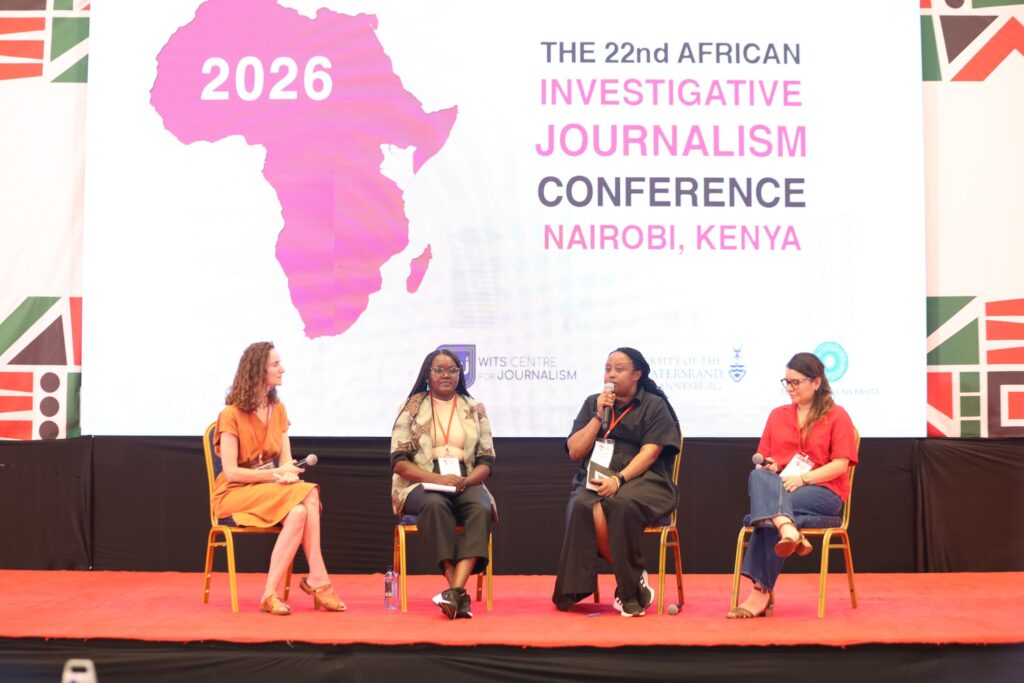
Beyond the keynote presentations and major investigations, several breakout sessions at the African Investigative Journalism Conference (AIJC) 2026 in Nairobi, Kenya, addressed practical challenges facing journalists and offered useful ideas for improving their work.
Women in Journalism in Africa: Career Progression and Leadership
Hosted by the Pulitzer Center and African Women in News, this session examined the experiences of African women journalists, including newsroom leadership, investigative reporting, career pathways and what it takes to succeed in the profession.
Speakers included Irene Odera of African Women in News, investigative journalist Joy Kirigia of Africa Uncensored and science writer Leonie Joubert. Rozina Breen of the Pulitzer Center moderated the discussion.
Practical lessons: Media organisations should examine opportunities for women to progress into editorial and management positions. Female journalists should also build professional networks, develop specialist reporting expertise, pursue leadership opportunities and document their professional achievements. Newsrooms should pay attention to the barriers that prevent women from participating fully in investigative journalism.
Making Impact Work in Journalism
This session examined the difference between publishing an investigative story and achieving measurable impact.
Drawing on the Pulitzer Center’s global research, Impact in Journalism: A Global Report on Current Practices, Challenges, and Emerging Trends, participants considered why journalists often lack the frameworks, dedicated personnel, resources and measurement tools needed to make impact reporting a consistent newsroom practice.
The discussion explored how newsrooms, independent journalists and engagement practitioners can move beyond occasional audience engagement activities towards a more deliberate approach to measuring impact.
Practical lessons: Journalists should consider the intended impact of an investigation before publication. They should identify relevant stakeholders, plan how affected communities can engage with their findings and monitor developments after publication. Impact documentation should include government responses, policy changes, institutional investigations, corrective action and improvements in people’s lives.
For Nigerian journalists, this means keeping an impact record for major investigations rather than treating publication as the end of the reporting process.
Fundraising: Finding Sustainable Support for Independent Journalism
Prue Clarke, Executive Director of New Narratives, shared insights into funding independent journalism beyond individual story grants.
She explained that New Narratives had raised as much as US$1 million annually since 2022 to support journalism in leading West African newsrooms.
The organisation’s funding sources included embassies, international foundations, individual donors and consortium arrangements. The session also explored opportunities for collaboration around future grant applications.
Practical lessons: Independent journalists and media organisations should not depend exclusively on individual story grants. They should identify potential institutional donors, build relationships with funding organisations and explore partnerships with other newsrooms when applying for larger grants.
Developing a clear organisational mission, demonstrating previous impact and presenting credible project proposals are important considerations when seeking funding.
The Three Pillars of Environmental Reporting
Led by Ibrahim Khalilulahi Usman of the Africa Zero Waste Journalist Network, this participant-led session examined how journalists can report environmental issues accurately without confusing them with climate change.
The discussion addressed a recurring reporting problem: environmental stories are sometimes automatically presented as climate stories even when the evidence does not establish a direct climate connection.
Using investigative reporting examples, the session encouraged journalists to understand the actual environmental issue they are reporting and establish its relationship, if any, with climate change.
Practical lessons: Journalists should distinguish between environmental degradation, climate change and other related scientific issues. A report about flooding, for instance, should not automatically attribute the flooding to climate change without supporting scientific evidence.
Journalists should consult environmental scientists, researchers and relevant datasets, verify claims and explain the difference between established facts and scientific projections.
The published session description does not enumerate the three pillars individually, so it would be inappropriate to present an unverified list as the speaker’s framework.
Investigating AI-Powered Scams: OSINT Techniques for Journalists
Presented by Nurudeen Akewushola of the International Centre for Investigative Reporting (ICIR), this session examined how journalists can use open-source intelligence (OSINT) and digital forensic tools to investigate online scams involving artificial intelligence.
Drawing on his investigation into fraudulent AI-powered investment schemes targeting Nigerians, Akewushola demonstrated how scammers use deepfake videos, synthetic identities, cloned voices and manipulated endorsements to create false credibility.
The session introduced practical investigative techniques, including:
Using InVID-WeVerify to examine and verify manipulated video content.
Examining domain registration records to trace the infrastructure behind fraudulent websites.
Using AI-detection tools as part of the verification process.
Searching online communities such as Trustpilot and Reddit to identify victims and follow the development of scams.
Investigating how social media platforms amplify fraudulent investment promotions.
Practical lessons: Nigerian journalists should develop the ability to investigate online investment schemes rather than simply report warnings issued by regulators.
They should verify the identities of individuals promoting investment opportunities, examine the registration and history of associated websites, trace suspicious digital connections and independently contact alleged victims.
AI-generated videos and endorsements should never be accepted as evidence of an individual’s involvement without independent verification.
Cross-Border Investigations: The Importance of Collaboration
Cross-border investigations featured among the major themes of the conference. The gathering brought together journalists from different African countries to share investigations and explore collaborative approaches to reporting issues that extend beyond national boundaries.
The opening conference reports identified cross-border investigations as one of the important areas of professional exchange.
Practical lesson: Nigerian journalists should consider collaboration when investigating issues involving multinational corporations, international financial transactions, human trafficking, organised crime, illegal resource exploitation and digital fraud.
Such investigations may require journalists to work with colleagues in other countries who can obtain local documents, interview sources and verify information that would otherwise be difficult to access.
Whistleblower Protection and Undercover Reporting
The conference programme identified whistleblower protection and undercover reporting among the important subjects for discussion.
These are particularly relevant to investigative journalism because some investigations depend on information from insiders or evidence that cannot easily be obtained through conventional reporting.
Practical lessons for Nigerian newsrooms: Editors should establish procedures for receiving confidential information, verifying whistleblower claims and protecting sources from unnecessary exposure.
Undercover reporting should also be subject to clear editorial approval, a demonstrable public-interest justification and an assessment of the legal and ethical risks involved.
*Curated by AI based on reports and posts by participants and organisations that participated in the conference.