For years, I attended international media conferences to learn, network and listen. At the 2026 Global Media Forum in Bonn, Germany, that changed. For the first time, I was not in the audience but on the stage, invited to share not just my work as a journalist, but the personal cost of pursuing accountability and investigative journalism in Nigeria – the threats, court battles, trauma, intimidation and the lessons that have helped me continue reporting despite them. It was a deeply personal conversation that reminded me that telling our own stories can be just as important as telling everyone else’s.
When I received the invite for the session, I searched deep within myself and knew I had to recall the days I really dread, the unspoken fears that sometimes come up whenever I do some investigation that I know would step on some toes, or even write a social media post that I know would infuriate someone. But then, I realised that if I don’t share my story, how would other journalists, especially female journalists, be encouraged to undertake journalism that seeks accountability and speaks for the voiceless?
And so I prepared. I tried to recall a lot of things, a lot of incidents (that’s when I realised that I may need to start keeping a journal.). The picture attached shows the book where I tried to put all my thoughts together so that I won’t forget or misrepresent anything when I want to speak. So armed with the book, I waited for my session, which was on the second day of the Global Media Forum.
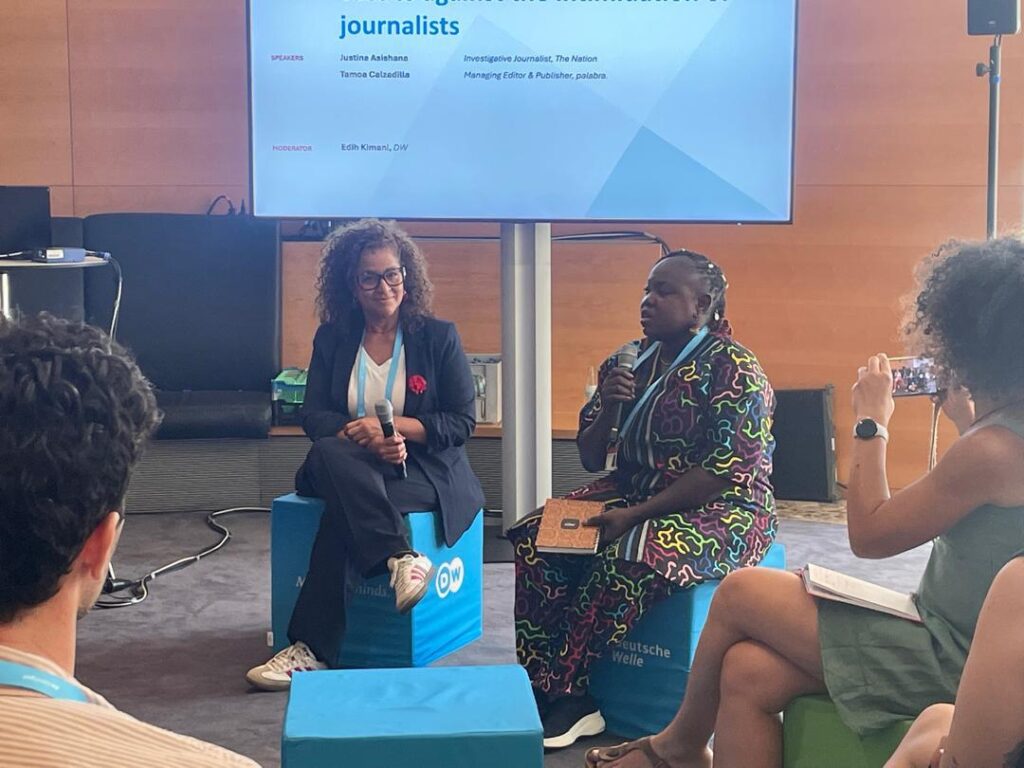
The title of my session was “From Vulnerability to Resilience: Tactics against the intimidation of journalists”.
Journalists often find themselves on the frontlines. The nature of our profession makes us targets of hate speech and deliberate hostility. These attacks not only erode the foundations of press freedom but also pose an immense personal burden to those on the receiving end. The session was meant to confront the brutal reality of harassment head-on, offering concrete tactics to counter attempts at intimidation. We were asked to combine personal testimony with practical strategies on how we have been able to transform vulnerability into resilience.
My co-panellist was Tamoa Calzadilla, who is the Managing Editor and Publisher of Palabra. She is a Venezuelan who is now a migrant in the United States of America. Her passport has been seized, and she is now a persona non grata in her country. In her own words, “it is like I had no life in Venezuela, or it was as if I never existed there”.
On the 2nd day of the GMF, my session was held in the morning alongside other breakout sessions. Sincerely, I did not expect the room to be full because other sessions were just as exciting as ours, but it was full.
Armed with my book of points to speak (the picture aptly captures me holding the book) but I did not even open my book at all because the questions touched on what I have experienced in field reporting, how I have coped with digital and physical threats, why I keep reporting in a area that have security threats and the likes and I was able to respond to them. I spoke about how and when intimidation stopped being abstract to me. I gave instances of being threatened by a political candidate as a result of what I wrote on my Facebook page, how I was almost struck in a town where I went to interview sources and bandits attacked a town close by, I spoke about my court case which almost disrupted my activities for two years, I spoke about how I had to take time to deal with mental health issues especially after some reports that really affected me.
I also spoke about how political and non political actors are using the cyber crimes act to intimidate and harass journalists in Nigeria and how these actors often hide under the phrase of “causing a breakdown of law and order” to justify cyber crime charges against journalists and how some journalists are being forced to self-censor themselves in order not to fall victim of these charges because the goal is not to convict the journalist but to exhaust them and their media organisation financially, legally and mentally until the cost of truth-telling and demanding for accountability becomes too high to bear.
When asked to give tactics of what has worked for me, I said the need to ensure you verify all claims you are making and, if possible, have documents to back them up. Also, document all your findings, even including screenshots of your call logs and text messages, as it will help you in the long run if they come after you, legally. I also stressed the need to treat any intimidation as real threat, not to wave it away, the need to take your mental well-being serious, know when to pull back if it affects your mental health, ensure you have adequate preparations before embarking on field work and most importantly, the need not to isolate yourself, always have a group of like-minded journalists, groups or networks that you can speak to when you have concerns or challenges.
Lastly, I spoke about resilience, and we discussed how resilience is now used to hide the harm journalists face and how journalists are expected to be resilient, as if nothing affects them, just to prove that they are resilient. I spoke about how journalists are praised for resilience when they continue working after threats, harassment, legal pressure or trauma and how many journalists are carrying trauma from stories they have covered, harassments they have faced, digital or open threats they have received and just move on to the next assignment as if nothing happened. I gave an example of myself when I was actively covering child rape and harassment cases, and how I had to start stopping me holding female children on the streets to know how related they are to them and sometimes won’t let it go until I see the mother or a female figure in the girl’s life. I spoke about how a friend informed me I was transferring the trauma of the cases I have listened to and observed to people on the street, which can be dangerous to me, especially if I meet an erratic parent.
I spoke about resilience as not pretending harm does not exist, but how one can work around it by building habits that will let you, as a journalist, keep reporting without becoming reckless.
My co-panellist, Tamoa Calzadilla, spoke about how she had to leave her country when the threats against her family became very real, when her home was burgled, and she had to wonder what would have happened if her children were home. That decided for she and her husband to leave the country and become immigrants in the United States. She also spoke about how she started Palabra, a media outlet of the National Association of Hispanic Journalists. She spoke of the challenges of living and working in another country and how she cannot get her Venezuelan passport back.
Our Moderator, Edith Kimani, the DW Bureau Chief in Nairobi, was skilled in asking questions and gave us ample time to respond. She also got the audience to participate by asking questions and making contributions about their own experience.
The Global Media Forum had over 40 sessions, the majority of which were breakout sessions, making participants select the one they wanted to attend. On my part, I attended sessions on AI and journalism, environmental reporting, fact-checking, and sustainability.
One of the high points of the conference was the networking boat cruise on the Rhine River, which was the best way to end the two-day intensive conference. On the boat cruise, there was a lot of networking and dancing, which made everyone unwind and enjoy the atmosphere given by the live band.
Some key takeaways for me were taken from the opening remarks of DW Director General Barbara Massing:
“AI transformation is here to stay. As journalists, we must embrace change, integrate innovation into our work, seize its opportunities and manage its risks.”
“Our theme this year is Journalism Out Loud, not because journalism needs to be louder, but because it needs to remain audible in a world that is becoming increasingly noisy. It means restoring journalism’s power to connect people and reaffirming the vital role of free media in our societies.”
“Journalism Out Loud also means remaining relevant in a world where the voices of journalists are increasingly pushed into the background. Journalism Out Loud means remaining relevant in a world of fragmented attention and earning trust in an age of organised doubt.”
“As the number of autocratic actors and regimes grows worldwide and truth is increasingly sacrificed to political or economic interests, journalism is becoming more dangerous. Hatred and harassment on social media translate into real-world threats against journalists. More than 500 journalists are in prisons worldwide.”
“According to Reporters Without Borders, more and more journalists are being forced into exile. Yet even in exile, many remain beyond the reach of safety. Authoritarian regimes extend their influence far beyond their borders. Journalists in exile continue to face threats and pressure.”
“Journalism requires courage. I am proud and grateful that there are so many people here today who are courageous and who stand up and discuss with us the future of journalism. One person who embodies that courage is Jimmy Lai, a steadfast advocate for press freedom and democracy in Hong Kong. He has paid a high price for his commitment and has been in prison since 2020.”
“More than 500 journalists are in prisons worldwide. Transnational repression has reached alarming new dimensions. Freedom of the press and freedom of expression are not luxuries. They are essential to democracy, security and free societies. Independent journalism is an investment in security, stability and economic growth.”