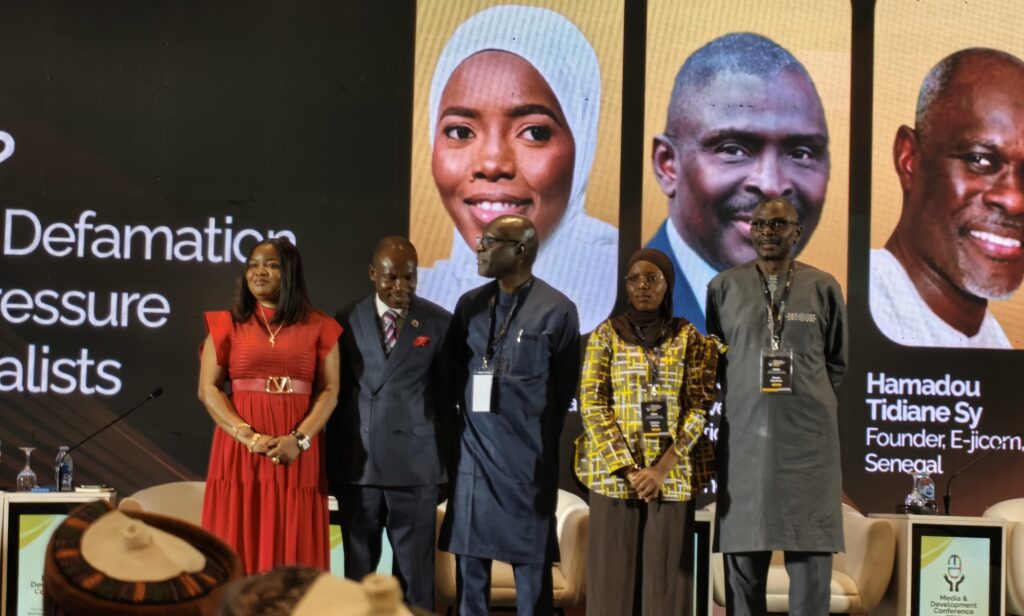
Costly lawsuits, cybercrime investigations and other forms of legal intimidation are increasingly forcing some newsrooms to resort to self-censorship, media leaders have warned.
They raised the concern during the third plenary of Day One of the 2026 Media and Development Conference organised by the Centre for Journalism, Innovation and Development (CJID) in Abuja on Monday.
The session, titled “Silenced by Law? Cybercrime Charges, Defamation Suits and the Legal Pressure on West Africa’s Journalists,” examined how legal actions and regulatory pressures are being deployed against journalists, with implications for investigative reporting, press freedom and democratic accountability.
Executive Director of the International Centre for Investigative Reporting (ICIR), Dayo Aiyetan, said frivolous lawsuits had become an increasingly common means of frustrating journalists and media organisations investigating powerful interests.
He said that the financial burden of prolonged court cases, coupled with police invitations, surveillance and cybercrime investigations, was exhausting journalists and discouraging young reporters from undertaking courageous investigative assignments.
Citing Wikki Times as an example, Aiyetan said the media organisation was facing more than 10 lawsuits, adding that such legal battles could drain the financial resources of independent newsrooms and distract them from their core responsibility of reporting.
He warned that the psychological and financial consequences of repeated legal confrontations extended beyond individual journalists to affect entire newsrooms, noting that the pressure was creating an environment in which journalists increasingly became cautious about publishing sensitive investigations, leading to self-censorship.
Aiyetan maintained that while the Nigerian Constitution mandated the media to hold public institutions and officials accountable on behalf of citizens, such responsibility would be undermined if journalists were unable to report corruption and other abuses without fear of legal retaliation.
He also advocated stronger collaboration between investigative media organisations and civil society groups to ensure that findings from investigative reports could be used to advance accountability and institutional action.
On media regulation, Aiyetan said Nigerian media stakeholders had previously responded to government efforts to regulate the industry by coming together to develop a media-led self-regulatory framework.
He, however, noted that public awareness and confidence in such mechanisms were important to ensuring that complaints against media organisations could be addressed without immediately resorting to litigation.
President of the Gambia Press Union, Isatou Keita, warned against placing the regulation of journalism entirely in the hands of government, arguing that this could give authorities the power to determine what journalists publish and potentially target critical media organisations.
She advocated media self-regulation and collective action among media organisations, saying unity among journalists and publishers was important in resisting attempts to weaken independent journalism.
Keita also drew attention to gender-based violence as a serious threat to women journalists, both within and outside newsrooms identifying harassment, intimidation and unwanted advances as some of the challenges confronting female journalists as she laments the absence of effective reporting channels and institutional mechanisms to address such incidents in many workplaces.
She called for greater attention to women’s safety and the creation of systems through which female journalists could report harassment without fear of further victimisation.
Founder of E-jicom, Senegal, Hamadou Tidiane Sy, emphasised the need to prepare journalism students for the realities of professional practice, including the economic and ethical pressures that influence media operations.
He said journalism education should go beyond teaching reporting techniques to help students understand the relationship between media ownership, funding and editorial independence arguing that professional integrity could not be developed through classroom instruction alone but required collective support from media institutions that would reinforce ethical principles in actual newsroom practice.
He also stressed the importance of helping young journalists understand the pressures they might encounter when working in politically sensitive or conflict-affected environments.
Deputy President of the International Press Institute (IPI), Nigeria Chapter, Dr Fidelis Mbah, urged journalists to strengthen professional ethics, particularly through thorough fact-checking, balanced reporting and giving all relevant parties the opportunity to respond before publication.
He said journalists needed to exercise caution and maintain professional accountability to minimise avoidable disputes and reduce their exposure to intimidation and legal challenges.
Mbah, who disclosed that experiences of arrest had affected him psychologically, said journalists also needed resilience when confronted with pressure from authorities urged media professionals to remain committed to responsible journalism while resisting attempts to undermine their work.
The session was moderated by Busola Ajibola, Deputy Director of CJID, and featured discussions on the growing legal, institutional and workplace pressures confronting journalists across West Africa.