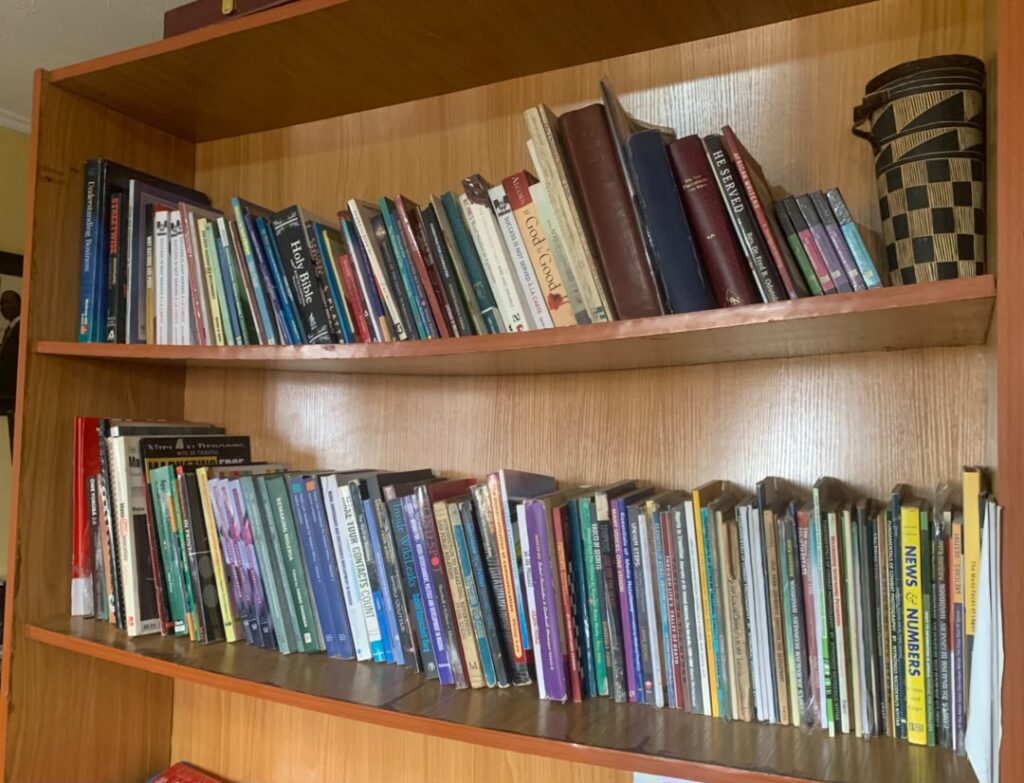
Our intern from the Lagos State University, Ojo, Olajumoke Jegede writes the various books and resources owned by our Executive Director in our office library.
What is a book on business doing on the shelf of a veteran journalist’s library?
Quite surprising, but not much of a great surprise to me. As I stood in the library and looked through the shelves, the words of one of my lecturers echoed in my ears: “Read far and wide… journalists read everything.”
And perhaps that was exactly what I was beginning to understand.
I was going through the office library of Mr. Lekan Otufodunrin, a veteran journalist, Editor and Author of books with over 40 years of experience in the journalism profession and the Executive Director of the Media Career Development Network, located in Ogba, Lagos. The library immediately felt like more than just a room filled with books. For me, it felt like a small reflection of the mind of someone who has spent decades in journalism.
The library itself is modern, with books neatly arranged on spiral shelves. Unlike the picture I had in my head of an old library belonging to a veteran, the books were still looking quite new and well kept.
As I moved from one shelf to another, I began to notice that a large part of the collection was expectedly centred around journalism, communication and the media profession.
There were books that could easily remind a communication student of courses taken in school. I found African Communication System in a Global and Digital Age by Mike Osuji, Voyage into the History of Nigerian Mass Media by Sina Aina, and Elements of Rural Broadcasting by Olufeko Onabajo, PhD.
Looking at these books as a student of communication and media, I could not help but think about how useful this library would be to a student journalist, a cub journalist, or simply anyone trying to understand the media profession better.
There were also books that seemed more practical than academic—handbooks, guides, media kits and “how-to” books. Books that could help someone become a better journalist, understand the profession and perhaps navigate some of its challenges.
But the library did not stop at journalism.
There were books about success, business and other areas of life. This was where I found the book that caught me by surprise: Understanding Business by McGraw-Hill/Irwin.
I honestly did not expect to find a business book in a journalist’s library.
But then again, perhaps I shouldn’t have been surprised.
My lecturer’s words came back to me: “Read far and wide. Journalists read everything.”
Maybe being a good journalist is not just about reading newspapers, journalism textbooks or books about the media. Maybe it is also about understanding the world that you are expected to report on. Business, politics, culture, religion, history, gender and society all become part of the journalist’s world at one point or another.
Moving away from the shelves to a table, I found another pile of books covering completely different subjects. These were books that dealt with society, women and the issues affecting people’s lives.
Among them were Save Our Sisters by Deborah Meroff and Don’t Mess With Their Flowers by Bukola Aderemi Ladigbolu. Their presence caught my attention because they showed another side of the collection—one concerned with women, society and the struggles that often require attention and conversation.
There was also Mother of the Multitudes: A Biography of Prof. Ebele Ofoma Eko by Betty Abah. A biography like this adds another dimension to the library. It is not simply about learning facts; it is about preserving the experiences and journeys of people.
And then, among all the professional and social books, I found spiritual books.
That was another interesting discovery for me. You could almost see that the collection was not limited to the professional identity of the person who owned it. There was also room for faith and personal interests.
The library also carries visible reminders of Mr. Otufodunrin’s journey through the journalism profession. His awards sit among the books, almost telling another part of the story. While the books represent the things he has read and learned, the awards represent some of the things he has achieved through the years.
Standing in the library, I began to see the shelves differently.
They were no longer just shelves filled with books.
They represented different areas of knowledge, different interests, different people and different stories. There were books for the journalist, books for the student, books for the person interested in business, books about society, books about women, books about faith and books about the lives of other people.
For a young journalist, especially a campus journalist or cub journalist, I believe a library like this can serve as a learning ground. It reminds you that journalism is much bigger than simply knowing how to write a news story.
A journalist must be curious. A journalist must read. A journalist must understand people and the society around them. And perhaps most importantly, a journalist must be willing to learn beyond the boundaries of journalism itself.
That is what I took away from my time inside Mr Otufodunrin’s office library.
To me, this place is more than a collection of books. It is a learning ground, a reflection of a journalist’s interests and experiences, and a place that holds stories—both of the people who wrote the books and of the person who chose to keep them.