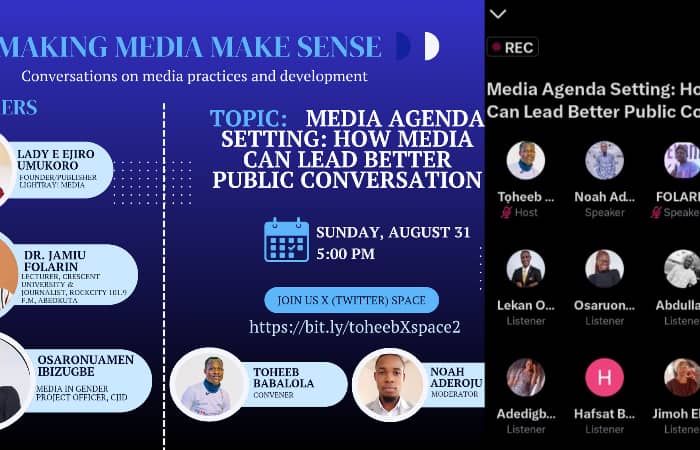
Media experts at the second edition of the Making Media Make Sense conversation have advised the mainstream media to rethink and reimagine its agenda-setting role to become of collaborative participation in the contemporary world of online information exchange.
The event, hosted on X Space, featured Dr. Jamiu Folarin, a journalist and media scholar at Crescent University, Abeokuta, and Lady Ejiro Umukoro, publisher and founder of Lightray Media. They discussed “Media Agenda Setting: How Media Can Lead Better Public Conversation”, highlighting the transformation from traditional media control to interactive, multi-stakeholder dialogue.
The experts made it known that with the advent of social media, the agenda-setting role of the media has evolved from the controlling and gatekeeping of public conversations to one where they have to collaboratively participate with other leading voices driving conversations online.
They explained that the original principles behind the agenda-setting role of the media are limiting and discriminatory, and that the power to set agendas and lead conversations is not exclusively reserved for the media.
Umukoro opined that the traditional agenda-setting model brought about by the traditional one-way mass communication media (Radio, TV and Newspapers) is limited and power-centric and reinforces biases. It positioned listeners as passive consumers, completely subject to media messaging without reciprocal engagement. Media editorial decisions determined story importance, analyst selection, and public discourse framing, thereby reinforcing gender and other social biases and giving more prominence to a few issues like politics while relegating other core development narratives.
Dr Folarin noted that the originating point of the media’s agenda-setting function stems from the constitutional freedom of expression, which is universal. The power of social media to give a platform to anyone has extended the opportunity to lead and drive public conversations to more people, as opposed to the ancient setup where headlines and editorials in newspapers are the cue for public debate.
Traditional agenda-setting model persists in online conversations
Despite these changes, the experts noted that elements of the traditional agenda-setting model remain, where governance control and authoritative voice dominance still shape public conversations online.
Folarin pointed out that mainstream media headlines still influence online discussions, and people often seek confirmation from traditional media after seeing social media posts.
He noted that traditional media’s headlines and editorial framing still drive online conversation and audiences still seek mainstream media confirmation of information from social media influencers. He said, “The mainstream media is also evolving. When you talk about social media influencers today, even media personalities are social media influencers themselves.” This, according to him, reinforces the belief that the traditional agenda-setting model still persists.
While story suppression is no longer possible, as single social media posts can expose information regardless of editorial control, platform algorithms and social media influencers’ focus still determine what trends and drive engagements online.
Umukoro also noted that while social media influencers might have hijacked the agenda-setting power of the mainstream media, they still operate with the established model of the mainstream media. “The media no longer sets agendas in the public interest. What dominates headlines is politics— because it sells. Print media sets the tone, and broadcast outlets follow without verification,” she stated.
She further noted how social media influencers further expand the problem by manipulating public conversations without the checks and balances historically provided by professional journalists.
What needs to change
Both Dr Folarin and Umukoro called for the media to evolve in its agenda-setting function to align better and contribute positively to online conversation.
Umukoro called on the need for journalists themselves, especially the on-air personnel on broadcast stations, to improve their treatment of issues on their programmes and better understand the new dynamics of information dissemination across digital platforms. Folarin added to this by calling for more digital and media literacy for even the journalists themselves and social media influencers driving conversation online.
Folarin also called for a collaborative approach between the media and social media influencers to drive better and more informed public conversations for the benefit of the audience. While the social media influencers are pulling the crowds into conversation, the journalists should contribute better, factual and contextual information to the online engagement.
Fact-checking of claims and helping the audience see more intricate lines in the conversations is the role of a journalist.
Community-centred reporting and solutions-oriented conversations were also prescribed for the media to better lead public conversations.