
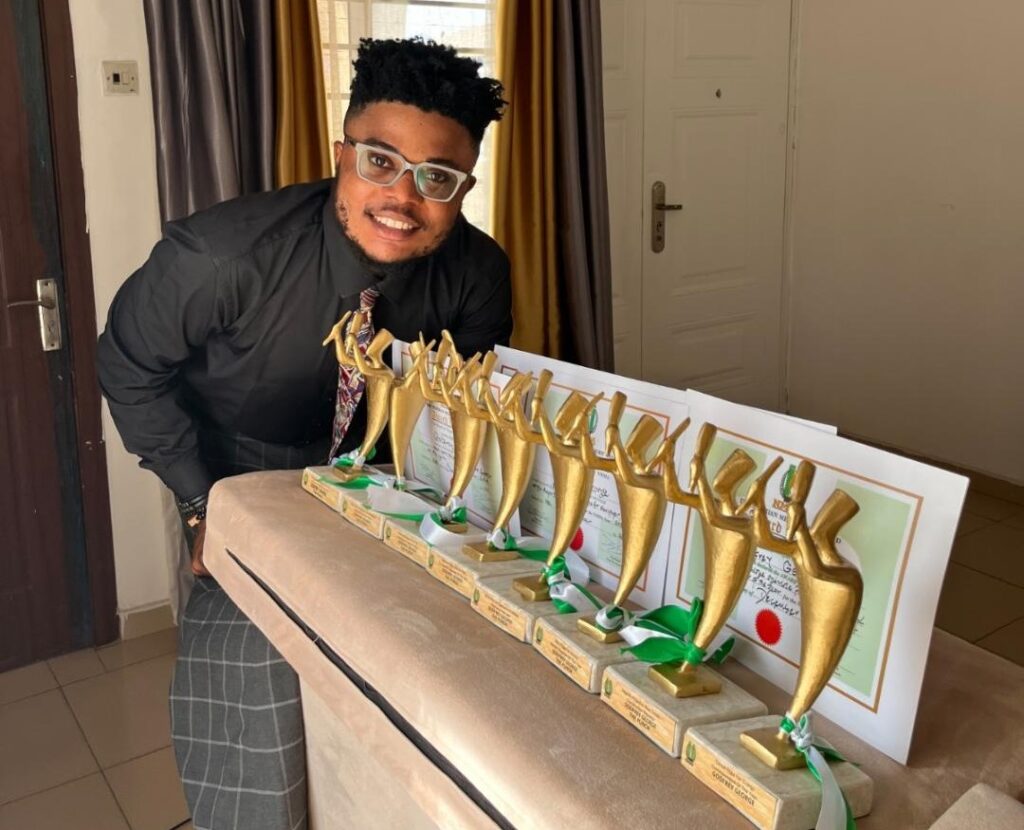
‘Awards, when they come, if they ever do, simply confirm that the work met a standard of excellence recognised by peers. They do not replace the work. They do not validate one’s humanity. And they certainly do not guarantee longevity. What they can do, when grounded in substance, is amplify credibility, open doors, and accelerate professional growth.’
Baptism into journalism
An ex-lover once told me I was a flirt. It confused me more than I ever admit. I don’t have an active social life. I don’t attend social gatherings. Church, for me, is on YouTube. I even forget my own birthday.
I remember May 1, 2022, when my mother called me so early in the morning. I was shocked. I think I panicked, and my blood pressure, I am sure, peaked.
I asked her if she was okay and if she needed me to call 911. Before she could say what was wrong, I picked up my other device and was dialling 112 after 911 gave me the “Call Failed” prompt.
“Happy birthday to you…” she sang after a short pause, perhaps to find the right key, or to confuse me even more.
I brought the phone closer to my eyes to be sure of the date, and yes, it was my birthday. May 1. I had forgotten. Again. My mother never forgets. I smiled as I quietly told the emergency operator I had dialled in error and that it was my birthday today. She wished me a happy birthday and hung up, while I continued talking with my mother on my other device.
“Come home soon to see me. I miss you. Try and come around this Christmas so we can spend some time together,” she said, taking soft breaths after each stop.
It had been one year since I left to pursue full-time journalism at PUNCH Newspapers, and I hadn’t gone home to see her, not because I didn’t love her or didn’t care, but because I genuinely didn’t have the time.
May 1, the previous year, my first actual byline went live on the PUNCH website. It was an interview with Assistant Inspector General of Police, Aishatu Baju, who also doubled as Queen of Mambilla. She had shared her story of rising to become one of the few female AIGs in the force and how she would still love to become a policewoman in her next life. It was my first commissioned interview by my editor, Dr Oladimeji Ramon, after my intensive three-week immersion training at the Punch Media Foundation. I left that place more confused than when I went in.
I had asked one of my friends, Percy Ani, if I hadn’t made a mistake choosing journalism, because, to me, everyone was just ‘too serious’ and everything looked like it could break if I touched it; too fragile, too delicate. The truth is that journalism is indeed a serious job. It is delicate, and it genuinely matters. You put out one wrong fact, one wrong quote, and a nation can slip into chaos. Lives may be lost. Trust broken.
I was too scared to ask why I would want to put myself in that position.
But I didn’t know that I had already caught the fire. Journalism fire.
As Mohbad and Chike, in their popular song Egwu, would put it, “Music (in this case, ‘journalism’) no need permission to enter your spirit.”
It was there that I met my mentors, Juliana Francis (formerly of New Telegraph) and Maureen Popoola (Lecturer at the Nigerian Institute of Journalism). I also met Mrs Ayo-Aderele (formerly HealthWise Editor), Eniola Akinkuotu (then, Abuja Bureau Chief) and Fisayo Soyombo (Founder, Foundation for Investigative Journalism). The fire these guys lit in me kept me awake at night for days. I wanted to do so much amazing work, and my head was burning with ideas.
But after spending several nights in the newsroom, I began to question that baptism. The mosquitoes in that newsroom then knew me by name. I remember hiding a small blanket in my drawer. I lived far away from the office, and I was not brave enough to join my other colleagues who left at night. Moreover, Mr Adeyeye Joseph (then, Managing Director Designate) warned us not to leave late at night, especially since most of us were not Lagos-based. We had been recruited from all over the country – that story is for another day.
“If production finished late, please, stay back if you can and leave by morning,” he warned. In fact, in my third month in the company, there was a strict policy that all ‘new guys’ should be allowed to leave at 8 pm. A bus was provided by Management to convey us to our closest bus stops. I was new, but most times, I always refused to leave at 8 pm. I always had work to be done.
Let me confess. Sometimes, I would go upstairs and hide, and come down only when the bus had left, so I would be allowed to stay back and finish my job. Those nights birthed mentoring sessions between Mr Gbenga Adeniji and me.
I remember during the June 2021 Twitter (now X) ban, and how the then News Editor, Mr Tunji Abioye (now Editor, The PUNCH) called me in the heat of production, and told me I was ripe to join the news team in writing the lead for that weekend. That man is a godsend. He entrusted me with so much as News Editor, and I learnt so much under him.
That ‘Twitter ban production day’, we finished production after midnight, and the Editor, Mr Dayo Oketola (now Chief Press Secretary to the Honourable Chairman of the Independent National Electoral Commission), had wondered how I was going to cope with staying back.
“Do you and your friends want to follow me home?” he asked, kindly. But I had declined on behalf of us all. My friends, Percy Ani, Noah Banjo (now Senior Editor and an African tech powerhouse) and Ms Peju Adenuga (who had come from the Business Desk) were enough company. I remember us talking about the profession and wondering whether we had made the right decision to do it full-time.
“See the time wey these guys close na. Na so we go dey close?” I had wondered in Pidgin English. But that baptism was already too deep; it was like I was initiated into an ancient cult. Like Adam, I had eaten the ‘forbidden’ fruit. I could now see I was naked. The more I wanted to leave, the more journalism drew me in until I got neck-deep, and leaving was no longer an option.
Love for books
I grew up in a home where books mattered. My father bought me a book almost every week. It did not matter what it was. Sometimes it was fiction, sometimes biographies, sometimes books far beyond my age.
What mattered was the habit. Reading became routine, and writing followed naturally. I would scribble thoughts into an exercise book, draw little scenes, and later read them aloud to my father when he returned from work. There was no applause, no audience beyond the living room, just a quiet encouragement that words were worth paying attention to.
At the time, I did not know this would become my life’s work. Journalism was not part of the plan. In secondary school, I flirted with the idea of banking. Later, Law was suggested. Broadcasting also hovered somewhere in the distance. I eventually studied English, not because I had mapped a career in media, but because it felt honest to who I was becoming. Storytelling, I was learning, was not something I chose. It was something that kept choosing me.
That instinct followed me into journalism. Slowly, quietly, without spectacle. Long before awards entered the conversation, there were long nights rewriting paragraphs, weeks chasing reluctant sources, and months working on stories whose impact I could not immediately measure. There were moments of doubt, exhaustion, and uncertainty. Yet, there was also a steady conviction that doing the work properly mattered, even when no one was watching.
Winning awards
Years later, that quiet commitment would find public recognition in ways I could never have imagined. In 2022, I was nominated twice at the NMMA. Runner-up wins. In 2023, I was also nominated twice or thrice. Also, runner-up wins. That same year, I was a finalist at the West African Media Excellence Awards (WAMECA) held in Ghana for my work on child pornography and revenge porn. Then, in 2024, a breakthrough came. I was nominated 11 times across nine categories at the NMMAs. I won three: Aviation, Maritime and Real Estate/Construction. I was runner-up in the rest. There were several others that year, both internally at PUNCH and externally.
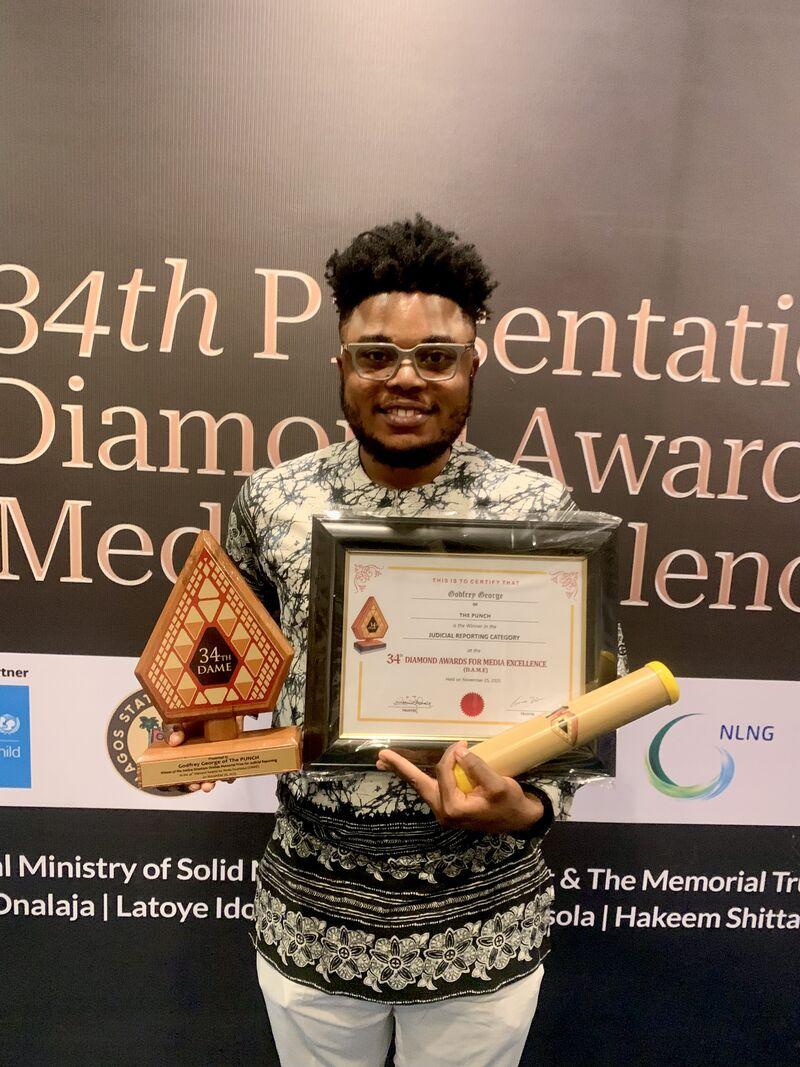
In 2025, I won eight awards at the Nigeria Media Merit Awards – Money Market, Real Estate/Construction, Maritime Reporting, Newspaper Features Writer, Telecommunications, Investigative Writing, Energy Reporting, and Culture and Tradition – the highest by any journalist in the awards’ 33-year history, alongside a Diamond Awards for Media Excellence win in the judicial reporting category for my story of children languishing in correctional facilities.
The moment was overwhelming and deeply humbling. But beyond the applause, it compelled me to reflect on something more important: the true value of media awards in career development, and what they really represent.
Awards are simply what they are
One of the most dangerous misconceptions young journalists carry is that awards are the work. They are not. Awards are simply what they are: awards. Some people see them as ‘the evidence’. This, too, can be true, because they are the visible outcomes of years of discipline, ethical judgment, curiosity, and persistence, often carried out without recognition.
Most of the stories that eventually won awards for me were never written with trophies in mind. Some took over a year from idea to publication. Others demanded multiple rewrites, difficult editorial conversations, and long periods of silence from sources. Some stories nearly died several times before finding their final shape.
Awards, when they come, if they ever do, simply confirm that the work met a standard of excellence recognised by peers. They do not replace the work. They do not validate one’s humanity. And they certainly do not guarantee longevity. What they can do, when grounded in substance, is amplify credibility, open doors, and accelerate professional growth.
Can awards shape a journalist’s career?
In practical terms, media awards influence careers in several important ways.
First, they strengthen professional credibility. Journalism is built on trust, and awards signal that a journalist’s work has passed rigorous scrutiny. This credibility often translates into access to better assignments, deeper sources, and greater editorial autonomy.
Second, awards expand professional networks. Recognition introduces your work to peers, mentors, and decision-makers you may never encounter otherwise. Some of my most meaningful professional relationships began because someone read an award-winning story or encountered my name on a shortlist.
Third, awards enhance negotiating power. Whether applying for fellowships, pitching investigations, or transitioning into new roles, awards provide tangible proof of impact. They shift conversations from potential to performance.
That said, awards only retain value when they are supported by consistent integrity and quality. Recognition that is not anchored in substance fades quickly. For me, after my NMMA/DAME win this year, it made me more humble in any space I found myself in. I move around with this consciousness that there is, as the Bible puts it, a cloud of witnesses to the work that I have put it. It’s such a heavy responsibility.
Understanding what the judges are really looking for
Awards are rarely about brilliance alone. They reward clarity, relevance, and impact.
Judges, I want to believe, are drawn to stories that ask necessary questions, expose hidden truths, or illuminate neglected experiences. They value originality, strong sourcing, ethical sensitivity, and narrative coherence. A polished story without depth often performs worse than a less glossy but deeply meaningful report.
Journalists who want to compete seriously must understand the award criteria. Each category has its own language and expectations. What works for you at the NMMA may be different at DAME, and also different at the West African Media Excellence Awards or Wole Soyinka Investigative Journalism Awards. Submitting work without this understanding is a missed opportunity.
It is also important to note that awards reward depth over volume. One carefully reported story with clear impact will almost always outweigh multiple shallow reports. Lastly, I would always tell journalists to read what other journalists write about. Read far and read wide and read wild. Read from CNN. Read from the BBC. Read Aljazeera. Read PUNCH. Read FIJ. Read AFP, Reuters, Semafor. Read The Cable. Read Premium Times. Read The Guardian, The Nation, and Daily Trust. Read Zikoko, The Sun, Nairametrics, New Telegraph, Bella Naija, The NYTimes, Condia, TechNext, The Mirror, Leadership, News Direct, Legit, Media Career Development, TVC Digital, Channels, ICIR, NatureNews, Tribune, TechCabal, The Sun (UK). Read biographies, self-help, and fiction. Read LinkedIn articles from thought leaders in journalism, the media, tech, culture, politics, geography and the economy, health, gender, children and climate and power. Read Physics and subscribe to as many newsletters as possible. Read actual books. Read anything and everything you can find. See what others are doing and how much you can learn from them. The more articles you read, the broader your mind and horizon will be.
The discipline behind award-winning works
Awards may be presented in a single night, but they are earned over the years. Behind every plaque is discipline.
This discipline appears in ordinary moments: choosing to fact-check one more time when tired, killing a weak angle and starting again, sitting patiently through difficult edits, and knowing when to push back or listen. It also involves emotional discipline.
Journalism exposes reporters to trauma, injustice, and human suffering. Some of my most recognised stories were also the most emotionally demanding. Carrying these stories responsibly, without exploiting pain or centring oneself, requires maturity and restraint. Awards tend to follow journalists who respect the weight of the work.
I remember working on a story about mentally ill pregnant women who are raped, impregnated and abandoned. During my field work, I was bitten by one of the women I was observing at a popular junction in Lagos. I was injured, and I bled. You needed to see how quickly I rushed to the hospital as I phoned my editor, Madam Tessy Igomu, who asked me to be calm and get tested first. I googled every and anything on the matter. I even had a colleague tell me that, in seven days, I may become mentally ill. Mr? Mentally ill ke? So, I was so conscious that I took some days off, so if I started exhibiting the symptoms, no one would be there to see me. It is funny now to me, but I tell you it was not funny then. It’s even interesting to note that the work didn’t even get a nomination in the category I put it for at the NMMA. Another, on randy fathers who impregnate their daughters, did and won in that category.
Collaboration and institutional support matter
No journalist wins alone. Every award sits on a foundation of collaboration and institutional support.
Editors who believe in story ideas early, colleagues who offer feedback or quiet encouragement, and institutions that allow journalists the time and space to think all play critical roles. Strong newsrooms create environments where excellence is possible. They allow journalists to fail safely, revise deeply, and pursue stories with rigour.
At PUNCH, I am grateful for the gift of a large family. Everyone is willing to help. The story idea on Day Care was first mentioned to me by a confidential secretary at the company, Aunty Ebun. I was on leave at the time. So, when I got another source reecho that same thought, I knew I should pursue it. It won me an NMMA. I have had ad executives pitch me story ideas. Even a driver had mentioned a story I could pursue. And the editors are wonderful. Special thanks to Mr Olusola Fabiyi (Former Editor, Weekend Titles). He is a father indeed. Mr Dayo Oketola (Pioneer Editor, Weekend Titles), Gbenga Adeniji, Mr Lekan Otufodunrin, Biodun Sonowo (Former Chairman, Editorial Board), Mr Obafemi Obadare (Chairman, Editorial Board), Juliana Francis, Sharon Osaji, Victoria Edeme-Nwahiri, Mrs Maureen Popoola, Sarah Ayeku (Senior Investigative Reporter), Esther Omopariola, Dr Oladimeji Ramon (my first desk editor) and my colleague and bosom friend, Mr Victor Ayeni. They were always willing to help.
For young journalists, choosing where to work matters. Seek spaces that value mentorship, ethical clarity, and editorial depth.
Pursuing awards deliberately is not wrong. What matters is how it is done.
Build a body of work you respect, even if it attracts no immediate attention. Focus on beats that genuinely interest you. Depth comes more naturally when curiosity is sincere. Read widely beyond journalism. Context sharpens reporting.
Document your work carefully. Keep clean copies of published stories and notes on impact. When award season comes, preparation reduces anxiety.
Above all, protect your integrity. Never compromise facts, sources, or ethics for recognition. Awards gained at the expense of truth eventually become burdens.
What awards do not do
Awards do not make anyone invincible. They do not prevent mistakes or shield one from grief. Some of my most celebrated moments arrived during one of the hardest seasons of my life. Recognition did not erase that loss. It simply reminded me that joy and pain can coexist.
Awards should never become an identity. They are milestones, not destinations.
Journalism found me quietly, through books, curiosity, and persistence. Awards followed much later. The order matters. Let the work come first. Everything else will find its place.
George, the most awarded journalist in the history of the Nigerian Media Merit Awards (NMMA), is a multimedia investigative journalist. A Fellow of the African Centre for Development Journalism and Digital Public Infrastructure (MFWA–Co-Develop), he reports on police abuse, governance failures, climate change, technology, the environment, women’s and children’s digital violations, and human rights.
READ MORE 2026 MEDIA CAREER OUTLOOK: What the Newsroom Taught Me and Where It Couldn’t Take Me