AI is not waiting for Nigerian journalists to catch up. From fact-checking to translation and captions, it’s already in our newsrooms. The question is simple: will AI take your job, or will you learn to make it your ally?
The conversation about artificial intelligence (AI) and jobs often swings between two extremes. On one side, there are alarmists who declare that AI will wipe out entire professions. On the other side, there are optimists who say AI will only create new opportunities and no one should worry.
Both views miss a crucial point: AI will take jobs. Maybe not yours – if you learn how to use it.
The False Comfort of Denial
It is misleading to give professionals, especially journalists, false hope that their jobs are safe without explaining the real shifts happening in the industry. In Nigeria and around the world, newsrooms are already experimenting with AI for:
Routine reporting: International outlets like Reuters and AP already use AI to produce financial reports and sports updates. Nigerian newsrooms are not far behind. Some online platforms are testing AI-generated summaries for news briefs.
Research and fact-checking: Fact-checking organisations in Nigeria, such as Dubawa and Africa Check, are experimenting with AI tools to track misinformation, especially during elections.
Translation and accessibility: The BBC Pidgin service has piloted AI-powered subtitling to make its English-language content more accessible to wider Nigerian audiences.
Audience engagement: Channels TV and Arise News are increasingly using AI-driven captioning tools during live broadcasts. Some Nigerian digital outlets also rely on AI to push personalised content on social media.
The truth is simple: if journalists ignore these changes, they risk being replaced or sidelined by systems that are cheaper and faster. The danger is not distant — it is already here.
What AI Cannot Replace
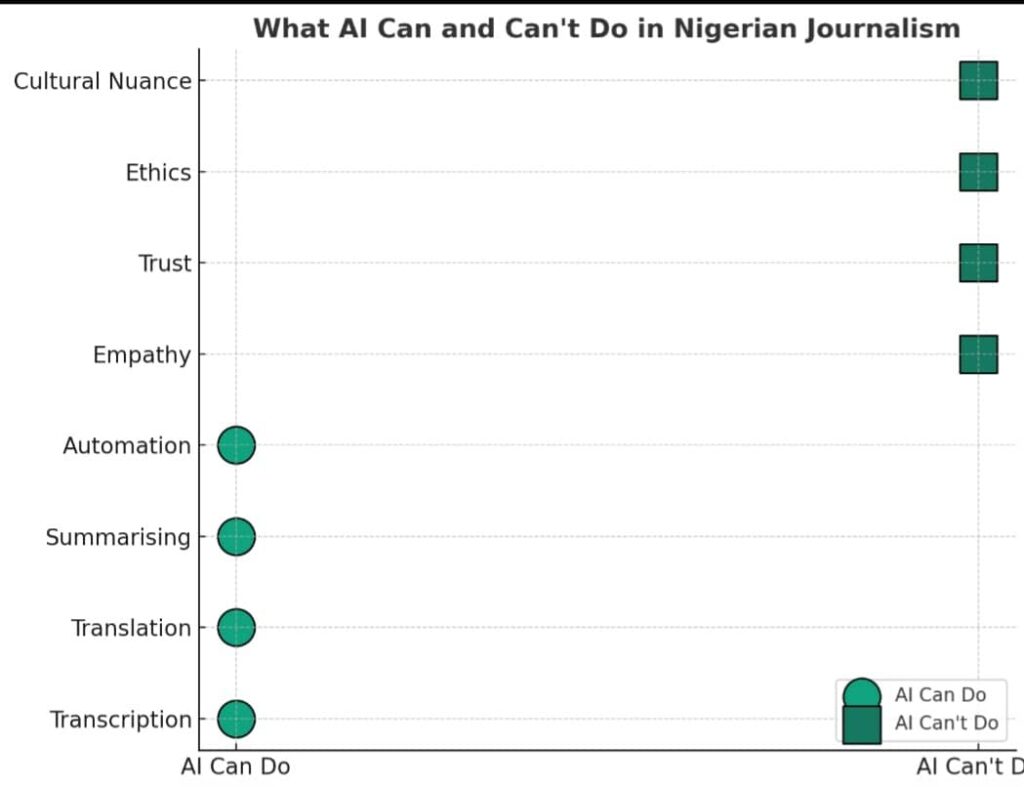
Still, journalism is more than content generation. Even in Nigeria, AI cannot:
Knock on doors in difficult communities to find the human angle
Build trust with sources in government, business, or civil society
Apply ethical judgment in stories about religion, ethnicity, or security
Understand cultural nuance, like how a story lands differently in Kano, Port Harcourt, or Lagos
Tell stories with empathy and lived Nigerian experience
This is where the enduring value of journalists lies. But only those who combine these human strengths with AI’s speed and efficiency will remain relevant.
How Nigerian Journalists Can Respond
To avoid being sidelined, Nigerian journalists must begin to:
1. Learn AI tools – Start small: use AI for transcription of interviews, summarising long documents, or background research.
2. Focus on what’s uniquely human – Double down on investigative reporting, ethical reasoning, and culturally rooted storytelling.
3. Adapt continuously – Technology will not wait. Nigerian journalists should seize AI training opportunities, join professional AI learning groups, and stay updated on global media trends.
4. Think career resilience – Your career is safer when you can prove that AI is your collaborator, not your replacement.
AI Tools Nigerian Journalists Can Start Using Today
1. Otter.ai / Fireflies.ai – For transcription
Record interviews and automatically generate transcripts.
Saves time on long interviews, especially in noisy press environments.
2. ChatGPT (or similar large language models) – For drafting and summarising
Summarise long reports, generate interview questions, or explore angles for a story.
Use responsibly: always fact-check outputs.
3. DeepL / Google Translate with AI upgrades – For translation
Quickly translate stories into Nigerian languages or from Hausa/Yoruba/Igbo into English.
Useful for broadening reach beyond one audience segment.
💡 Tip: Start with one tool. Experiment in your workflow. Share what works with colleagues. The best way to stay ahead is to keep learning.
📰 What AI Can’t Do in Nigerian Journalism
1. Investigative Courage
AI cannot knock on doors in communities, dig into hidden files, or persuade reluctant sources to speak.
2. Cultural & Religious Sensitivity
AI does not understand how a story on ethnicity, faith, or politics might be received differently in Kano, Enugu, or Lagos.
3. Ethical Judgment
AI cannot decide what is fair, balanced, or harmful in Nigeria’s fragile media landscape.
4. Human Trust
Sources talk to people they trust, not machines. Building relationships is still your edge.
5. Empathy in Storytelling
AI may produce text, but it cannot capture the human emotions that give Nigerian stories power.
💡 Your strength lies in combining these human qualities with AI’s speed and efficiency.
The Bottom Line
AI is not a passing trend. It is a permanent shift in how work gets done. For Nigerian journalists, ignoring it is career suicide. The smart choice is to treat AI as a colleague, not a competitor.
Those who adapt will not only keep their jobs, but also do them better. Those who refuse to learn will find themselves left behind.
AI will take jobs – maybe not yours, if you start learning today.
👥 Join the Conversation
💬 How are you already using AI in your newsroom or reporting? Reply to this newsletter and share your experience — we may feature your story in a future edition of Nigeria MediaAI Insight.